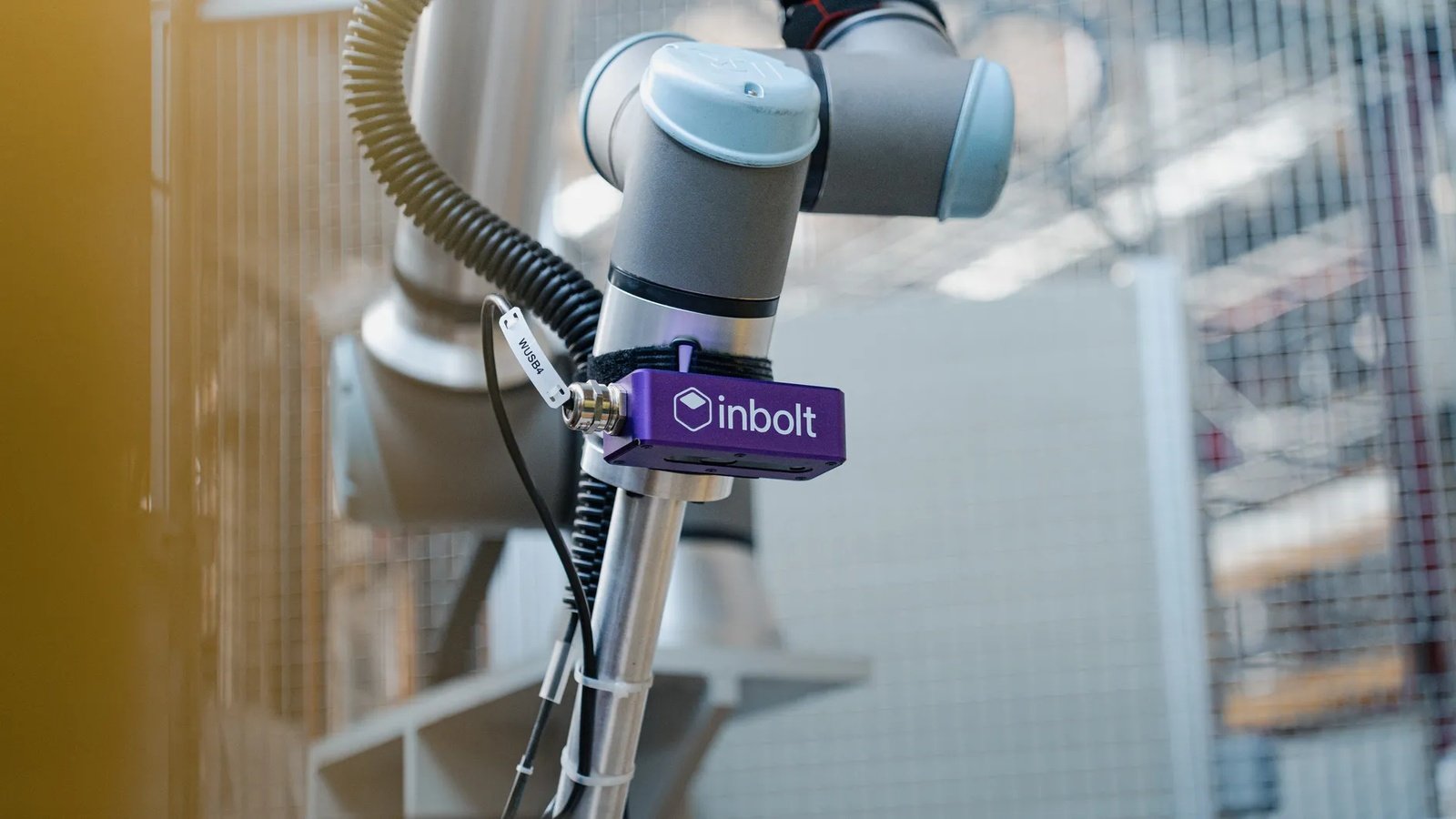
Universal Robots Gen 7 now integrates Inbolt 3D AI vision directly into its robot controller, removing the need for an external industrial PC and simplifying robotic automation for CNC machine tending, component handling and assembly. For manufacturers, the development could reduce reliance on dedicated positioning fixtures and make production changeovers easier to manage.
Announced on 24 November 2026, the integration of Inbolt Standard into Universal Robots’ seventh-generation platform addresses one of the challenges of high-mix manufacturing: automating production when components do not arrive in exactly the same position every cycle.
Rather than relying entirely on dedicated positioning equipment, manufacturers can use 3D machine vision to compensate for variations in component position and orientation.
How Universal Robots Gen 7 uses 3D AI vision
Inbolt Standard combines a wrist-mounted 3D camera with CAD-based component recognition. The system identifies the position and orientation of a component before adjusting the robot’s programmed trajectory.
This allows the robot to adapt its movements to the actual position of the component rather than relying entirely on predetermined coordinates.
Potential industrial applications include CNC machine tending, component loading and unloading, screwdriving, rack loading, layered depalletising and automotive assembly.
For machine shops handling multiple component references, the technology could reduce the need to manufacture dedicated positioning fixtures for every new job.
3 key advantages of Universal Robots Gen 7
Removing the external industrial PC
One of the most significant developments is where the vision processing takes place.
Inbolt Standard runs directly on the CB7 Core controller. On compatible g-Series robots, the camera connects through the robot’s tool flange, removing the need for additional external vision computing hardware and camera cabling along the robot arm.
This could reduce installation complexity, cabinet space requirements and the number of hardware components that maintenance teams need to support.
Reducing reliance on dedicated fixtures
Traditional robotic automation often requires components to be presented in precisely defined positions.
By identifying components using 3D vision and CAD data, Universal Robots Gen 7 with Inbolt Standard can compensate for certain positioning variations during each production cycle.
For subcontract manufacturers working with smaller batches and frequently changing component designs, this could reduce the engineering effort associated with part-presentation tooling.
Simplifying production changeovers
CAD-based component recognition offers manufacturers an alternative to developing new physical positioning arrangements for every component reference.
Where component geometry, gripper design and application tolerances permit, introducing a new part could become a more software-led process.
The commercial benefit will depend on how frequently production changes and how much additional engineering is currently required between jobs.
What Universal Robots Gen 7 means for CNC machine tending
High-mix, low-volume manufacturing remains a challenging environment for robotic automation. Frequent changeovers and variations in component geometry can make conventional automation expensive to implement.
A vision-guided cobot could locate components presented in trays or racks, compensate for positioning variations and load them into a CNC machine.
However, eliminating positioning fixtures for robotic picking does not eliminate the requirement for accurate workholding during machining.
Manufacturers must still consider chuck or vice positioning, gripper selection, insertion tolerances, machine interfaces and collision risks.
The opportunity is therefore in reducing unnecessary part-presentation tooling rather than removing fixtures from the entire manufacturing process.
Integration, compatibility and installation
The native integration brings Inbolt’s vision processing onto the Universal Robots Gen 7 CB7 Core controller.
This is particularly relevant for manufacturers looking to introduce vision-guided automation without adding a separate industrial computing platform.
However, buyers should confirm the compatibility of their specific robot model, controller, software version and camera configuration before investing.
Manufacturers operating existing Universal Robots installations should not assume that the integration is available as a straightforward software upgrade across all robot generations.
Vision repeatability must also be distinguished from the accuracy of the complete robotic operation. Applications involving precision insertion, reflective machined surfaces or tight loading tolerances should be validated using actual production components.
According to the official Universal Robots announcement, the system offers the following technical capabilities:
| Feature | Specification |
|---|---|
| Vision repeatability | 0.5–0.7 mm on stationary parts |
| Component training | Less than 10 minutes |
| Robot controller | CB7 Core |
| Programming environment | PolyScope X 10.13 or later |
| Camera | Orbbec 3D camera |
| Data processing | Local, on the robot controller |
| Component references | More than 80 within a single programme |
Compatible g-Series models include the UR10g-1750, UR17g-1300 and UR18g-950. CB7-equipped e-Series and UR Series robots are also supported but require external camera cabling.
Evidence from industrial production
Universal Robots and Inbolt have been working together since 2022, with vision-guided robotic cells already operating in manufacturing facilities across Europe and North America.
At a Stellantis engine assembly station, Universal Robots reports that Inbolt technology reduced tightening failures by 91%, with vision processing taking just 0.5 seconds per engine.
While these figures demonstrate the potential of adaptive vision guidance, they relate to an existing industrial application rather than an independently verified performance benchmark for the new Gen 7 integration.
The development also reflects a wider industry movement towards simplified robot vision deployment, as we explored in our recent coverage of the ABB AI Robot Trainer.
Why it matters
For smaller manufacturers, Universal Robots Gen 7 could offer a more accessible route to vision-guided automation.
Removing additional computing hardware and reducing dependence on dedicated positioning fixtures could make robotic automation commercially viable for a wider range of production volumes and component types.
However, different applications require different approaches to vision and gripping. As we discussed in our coverage of Festo GripperAI, handling unfamiliar or randomly positioned objects presents different challenges from locating known components using CAD data.
Manufacturers should therefore select vision technology based on the actual production task rather than the presence of AI alone.
MTN Analysis
We see the integration of Inbolt Standard into Universal Robots Gen 7 as a significant step towards more accessible and flexible robotic automation.
The most interesting development is not simply the addition of AI vision, but the potential reduction in engineering work required to introduce automation into an existing production environment.
For machine shops, the ability to introduce new component references through software could help address one of the commercial barriers to automating smaller production batches.
We are seeing a similar emphasis on reducing integration complexity elsewhere in the industry, including the recent machine vision collaboration between MVTec, Bosch Rexroth and BMG.
Before investing, we would encourage manufacturers to request demonstrations using their own components, assess complete production cycle times and compare the total installation cost against conventional fixture-based automation.
The real measure of success for Universal Robots Gen 7 will be how reliably it handles production variation and how much engineering time manufacturers can save when introducing new jobs.
FAQ
Does Universal Robots Gen 7 require an external PC for Inbolt 3D vision?
No. Inbolt Standard performs vision processing directly on the compatible CB7 Core robot controller.
Can Inbolt Standard handle randomly positioned components?
The Standard licence is designed for stationary applications where components arrive in a reasonably consistent orientation. Manufacturers requiring fully random bin picking should confirm suitable solutions with Inbolt.
Does Inbolt Standard require cloud connectivity?
No. According to Universal Robots, component training and vision processing take place locally, without production data leaving the manufacturing facility.
How much does Inbolt Standard cost?
Public pricing has not been disclosed. Manufacturers should request a quotation covering the software licence, camera, integration, training and technical support.
When will Inbolt Standard be available?
The software is listed on the UR+ Marketplace. Universal Robots announced on 24 November 2026 that ordering through its distribution network would begin shortly. A specific commercial release date has not been confirmed.
Further Reading
- ABB AI Robot Trainer Cuts Robot Vision Commissioning Time by Up to 90%
- Festo GripperAI Lets Robots Pick the Unknown Without Reprogramming Every SKU
- Festo AI Strategy: From GripperAI to Predictive Maintenance and Self-Optimising Automation
- MVTec, Bosch Rexroth and BMG Simplify Machine Vision Integration With ctrlX OS