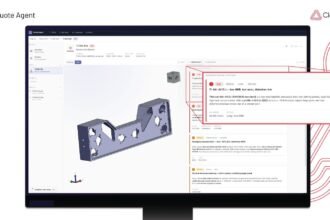
Give an engineer an image of a metal component and ask them to check whether a feature is missing. Which part of the image should they examine? Which software tools should they use, and in what order? Those questions run through 30 years of MVTec. In 1996, the Munich spin-off set out to put machine vision tools in engineers’ hands. In October 2026, it demonstrated a prototype that can choose those tools when an engineer describes the job and supplies images.
30 years of MVTec began in Munich
Dr Olaf Munkelt, Dr Wolfgang Eckstein and Dr Carsten Steger founded MVTec in 1996 as a spin-off from the Technical University of Munich and the Bavarian Research Center for Knowledge-Based Systems, known as FORWISS. Their early product, HALCON, brought a range of image-processing methods into one development environment. An engineer could combine the steps needed to locate a component, measure a feature and return a result within the same application.
One early decision still matters to anyone specifying an inspection station. MVTec concentrated on software and left users free to choose their cameras, lighting and automation hardware. A machine builder checking the profile of a stamped part and one reading a code on a casting could choose different optics and work in the same software environment.

From measuring features to learning what a defect looks like
A hole with a specified diameter gives a vision engineer a clear starting point. A blemish on a finished surface poses a different problem. Its shape, position and appearance can vary from part to part. MVTec expanded HALCON’s conventional image-processing methods, added 3D capabilities and began integrating deep learning into its products a decade ago. Learning from representative images gave engineers another way to tackle variation.
HALCON remains the development toolkit. MERLIC gives teams a more accessible way to build vision applications, while the Deep Learning Tool helps them prepare data for AI-based work. We’ve seen how that portfolio translates into production in our coverage of Endress+Hauser’s use of MERLIC in assembly inspection. Taking a check from a pilot to multiple assembly operations brings a different set of questions about how people run and maintain it.
Why it matters for the engineer building the inspection
At its October demonstration, MVTec turned AI towards the work of writing a vision application. Its AI Vision Solver prototype accepts a natural-language prompt and images. AI agents select operators from the HALCON library and assemble an executable workflow in HDevelopEVO. The engineer can start with a description of the inspection task and examine what the software produces. We covered the mechanics in our first look at AI Vision Solver.
That distinction matters on the shop floor. Generating a workflow raises a practical question. Can the software put together a sequence that runs? A production engineer still needs to establish whether it catches the defect across real batches, lighting changes and acceptable variations in finish. MVTec describes AI Vision Solver as a prototype. Its anniversary announcement gives no commercial release date.
MTN Analysis
Looking across 30 years of MVTec, we see the same engineering choice resurfacing. How much of an inspection can you reuse, and where do you need someone who knows the component? HALCON made individual vision operations reusable. AI Vision Solver explores whether software can also help choose and arrange those operations. For a team quoting a new inspection job, the interesting measure would be the time from the first sample images to a workflow they can test against known good and faulty parts.
Munich still houses all development and most of MVTec’s workforce of more than 300. Its in-house research team numbers around a dozen people. Integration and technology partners help customers connect that software to particular equipment. That division of labour helps explain how a specialist software company can serve applications as different as automotive assembly, semiconductor inspection and battery production.
Frequently asked questions
What is MVTec best known for?
HALCON, its industrial machine vision software, gives developers tools for tasks including measurement, identification, inspection and robot guidance. Engineers can use it with cameras and other hardware suited to their application.
What does the anniversary tell us about MVTec’s AI plans?
MVTec intends to expand how it uses AI in both image processing and application development. AI Vision Solver illustrates the second ambition. It uses a written task description and images to build a workflow from existing HALCON operators.