IDS Imaging Development Systems will use VISION 2026 to show how more intelligence is moving directly into industrial cameras and vision hardware, with new AI-capable uEye Live cameras, event-based imaging, embedded vision systems and upgraded 3D technologies all heading to Stuttgart.
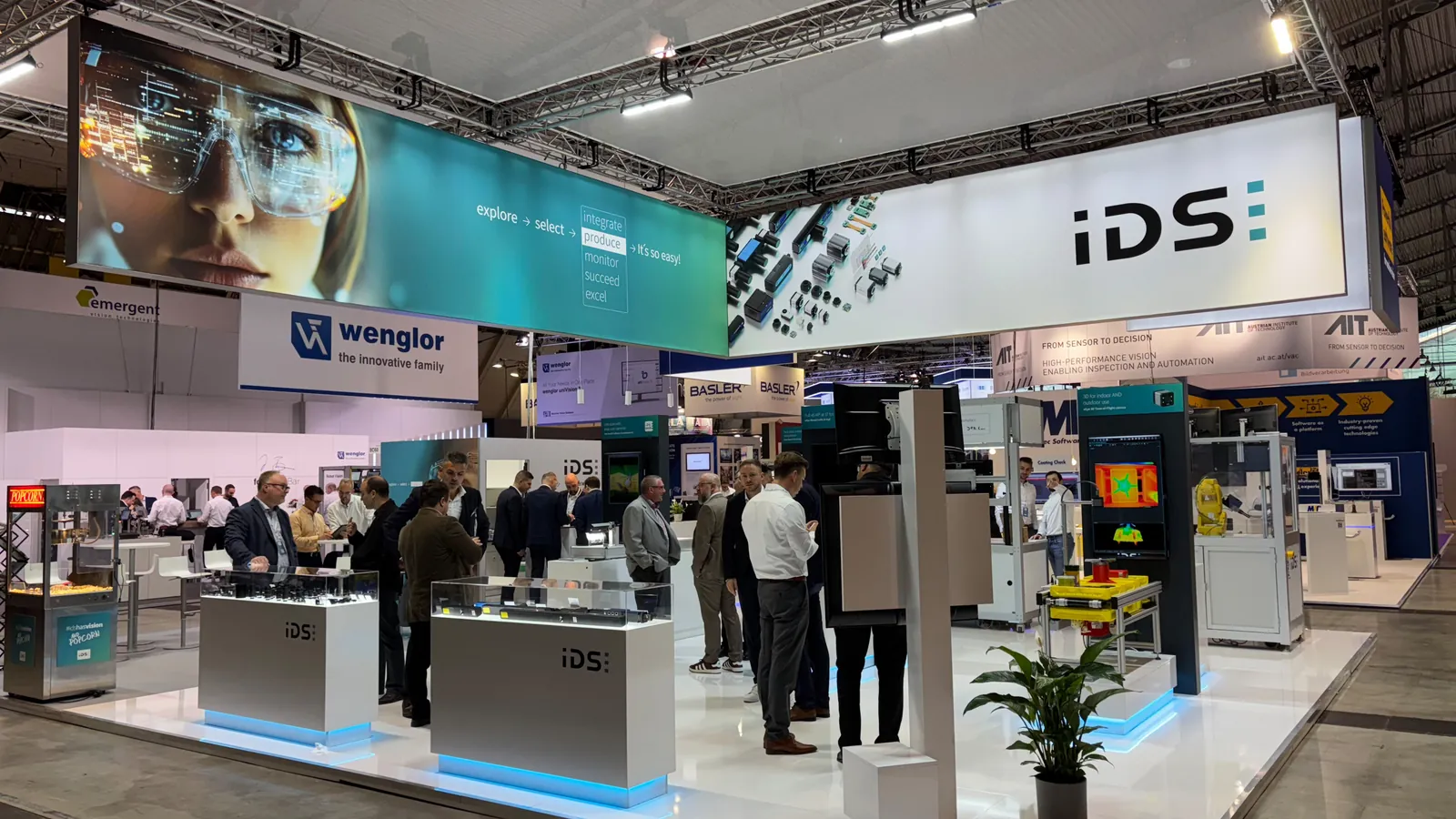
The company will exhibit in Hall 8, Booth 8C60 at Messe Stuttgart from 6 to 8 October 2026, under the theme “Trends. Innovations. Future.”
While IDS has a broad range of new camera technologies planned for the show, the development that stands out for manufacturers is the expansion of its uEye Live platform with AI-enabled camera models capable of running neural networks at the edge.
These systems are being designed to perform tasks including object and position detection, parcel handling and code reading, bringing AI processing closer to the point where the image is actually captured.
For machine builders, automation specialists and manufacturers looking at machine vision, robotics or automated inspection, that makes the IDS stand particularly relevant.
Visitors can find further information on the official IDS VISION 2026 page.
AI Moves Into the uEye Live Camera
One of the headline developments is the expansion of the IDS uEye Live monitoring camera series.
The platform already combines industrial monitoring with streaming and recording functionality. IDS is now adding AI-capable models designed to enable AI-powered image processing directly at the edge.
Neural networks from IDS partner DENKweit will support applications including fast object detection, position recognition, parcel handling and code reading.
This is an important direction for industrial vision.
Rather than every image needing to travel through a larger external processing architecture before a decision can be made, more of the intelligence can sit close to the camera and the production process.
MachineToolNews.ai has already examined how this approach is developing in manufacturing in our guide to Edge AI in Manufacturing.
We have also previously looked at IDS technology being used within an AI-supported inspection system combining an IDS uEye camera, edge computing and no-code AI software for shop-floor quality control. Read our IDS AI visual inspection article.
The VISION 2026 announcement shows IDS continuing further along that path by bringing AI capability directly into its own camera portfolio.
Jan Hartmann, Managing Partner at IDS, explains:
“Computer vision must do more today than just reliably capture images. It is crucial how quickly and easily image processing moves from an idea to a concrete application – and how well cameras, software and AI functions can be integrated into existing systems.”
That emphasis on integration is significant.
Manufacturers already have access to increasingly capable AI models. The commercial challenge is making those models straightforward to deploy within cameras, machines, robots and production systems without creating another highly specialised integration project.
New uEye Platforms Will Form the Basis of Future Industrial Cameras
IDS will also present new uEye vision camera platforms that are intended to form the technological foundation for upcoming generations of 2D industrial cameras.
The company says the new platforms are being developed around higher performance, straightforward integration and long-term availability.
That last point matters in industrial manufacturing.
Machine builders and system integrators typically need components that remain available and supportable over long machine lifecycles. A computer vision system has to deliver more than headline processing performance if it is going to become part of a production machine that could remain in service for many years.
IDS says its wider strategy is therefore centred on modular hardware and software that customers can combine into their own solutions, with support for customer-specific adaptations where required.
Event-Based Vision Targets Drones, AGVs and Autonomous Systems
Another major part of the IDS exhibition will focus on event-based image processing.
IDS is continuing its work with Prophesee and will demonstrate further developments in event-based camera technology aimed at highly dynamic applications including drones, automated guided vehicles and autonomous systems.
Event-based cameras operate differently from conventional frame-based cameras. Instead of continuously recording complete images at fixed intervals, individual pixels respond to changes within the scene.
That can dramatically reduce unnecessary visual data while allowing extremely fast motion to be detected, making the technology attractive for high-speed tracking and autonomous applications.
IDS sees applications including object detection, tracking and safe navigation.
The two companies have already commercialised IDS uEye EVS cameras using Prophesee event-based sensing technology and expanded their cooperation earlier this year around next-generation industrial vision systems.
At VISION 2026, visitors should get a clearer look at where that technology is heading next.
IDS Expands Its 3D Vision Portfolio
Artificial intelligence is only part of the IDS exhibition.
The company will also show developments across its 3D vision technology.
The Nion 3D Time-of-Flight camera is gaining a new RGB set designed for synchronised image acquisition, allowing colour information and depth data to be combined.
This can provide a richer representation of the scene for applications where both spatial information and conventional colour imaging are useful.
IDS will also present a new version of its Ensenso N series active stereo vision system, aimed at applications including robotics, bin picking and industrial measurement.
These applications are becoming increasingly connected with AI because intelligent robotic systems need reliable spatial information before they can understand, select or manipulate objects in changing environments.
GMSL Multi-Camera System Moves Processing Closer to the Device
One of the more interesting innovation projects on the IDS stand will be its GMSL Multi-Camera Vision System.
The concept demonstrates how images from several cameras can be processed and combined directly within an embedded vision system using integrated image signal processors and systems-on-chip.
The resulting data is then transmitted through a single GMSL connection.
IDS says this approach reduces latency and data load and could provide a foundation for projects using distributed cameras, particularly in mobile applications.
This fits closely with the wider trend visible throughout the company’s VISION 2026 announcement.
Cameras are increasingly becoming active computing devices within the automation architecture rather than simply image acquisition components.
IDS will also demonstrate active focus control integrated directly into the camera, with control and feedback handled through software. Target applications include logistics, autonomous systems and retail.
Multispectral Vision Targets Agriculture
IDS is also extending the scope of its innovation work beyond conventional industrial automation.
A new NDVI camera combines multispectral imaging with high-resolution colour imaging to analyse vegetation.
The system makes plant health visible and generates Normalized Difference Vegetation Index data that can support agricultural planning and resource allocation.
While this sits outside the core machine tool market, it provides another example of increasingly specialised imaging and local data processing being built around particular applications.
IDS Joins the VISION Makeathon 2026
IDS will also take part in the VISION Makeathon 2026 as a project company.
Interdisciplinary teams will be given a single day to develop practical prototypes addressing current image processing challenges, with IDS providing its own challenge, technology and technical expertise.
The format should provide an interesting test of one of the central themes running through the IDS announcement: reducing the distance between an image-processing idea and a working application.
MTN Analysis
The most important part of the IDS VISION 2026 announcement is the direction of travel.
Industrial cameras are taking on more intelligence.
The new AI-capable uEye Live models put neural-network processing at the edge. The GMSL project moves image processing and data combination into an embedded multi-camera architecture. Event-based cameras reduce the amount of unnecessary visual information that needs to be processed in highly dynamic applications.
Together, these developments point toward vision systems that can interpret and process more information before it has to travel elsewhere within the automation architecture.
That matters for robotics, inspection, logistics and autonomous manufacturing systems because many of these applications depend on decisions being made quickly and reliably from visual information.
VISION 2026 is increasingly shaping up as an important event for seeing how this shift is happening from both the hardware and software sides.
MachineToolNews.ai has already highlighted MVTec’s AI Vision Solver at VISION 2026, where AI agents will demonstrate how prompts could support the development of machine vision applications.
IDS is approaching the evolution from another part of the vision stack, putting AI, embedded processing, event-based sensing and new camera architectures directly into the imaging hardware.
Together, these developments show how AI is spreading across the complete machine vision workflow, from building an application through to processing information at the camera itself.
For manufacturers visiting Stuttgart to understand where industrial vision is heading, Hall 8 is going to be particularly important this year.
IDS will be located at Hall 8, Booth 8C60, from 6 to 8 October 2026.
Key Takeaways
- IDS will exhibit at VISION 2026 in Hall 8, Booth 8C60.
- New AI-capable uEye Live cameras will support neural-network processing at the edge.
- DENKweit neural networks will support object detection, position recognition, parcel handling and code reading.
- IDS and Prophesee will demonstrate further developments in event-based imaging for drones, AGVs and autonomous systems.
- New 3D developments include an RGB set for the Nion ToF camera and an updated Ensenso N series.
- The GMSL Multi-Camera Vision System demonstrates embedded processing across multiple distributed cameras.
- VISION 2026 takes place at Messe Stuttgart from 6 to 8 October 2026.
FAQ: IDS at VISION 2026
Where is IDS exhibiting at VISION 2026?
IDS Imaging Development Systems will exhibit in Hall 8, Booth 8C60 at Messe Stuttgart.
When is VISION 2026?
VISION 2026 takes place from 6 to 8 October 2026 in Stuttgart, Germany.
What AI technology will IDS show at VISION 2026?
IDS will show new AI-capable models within its uEye Live camera series. The cameras are being developed for AI-powered image processing at the edge using neural networks from DENKweit.
What can the IDS AI cameras detect?
IDS says the neural networks can support applications including object and position detection, parcel handling and code reading.
What is event-based vision?
Event-based cameras respond to changes within a scene rather than continuously recording complete conventional image frames. This can reduce data and provide extremely fast response times for highly dynamic applications.
Will IDS show 3D vision technology?
Yes. IDS will show developments for its Nion Time-of-Flight camera and a new version of the Ensenso N active stereo vision series for applications including robotics, bin picking and measurement.
Is IDS showing technology for robotics and autonomous systems?
Yes. Its event-based cameras, 3D vision technology, embedded multi-camera systems and active focus project all have applications relevant to robotics, autonomous systems and mobile automation.
Further Reading on MachineToolNews.ai
IDS Camera Technology Brings AI-Supported Inspection Closer to the Shop Floor
MVTec at VISION 2026: The AI Vision Solver Could Be the Show’s Must-See Machine Vision Demonstration
What Is Edge AI in Manufacturing and Why It Matters in 2026
MVTec MERLIC AI Machine Vision Moves From Endress+Hauser Pilot to Global Assembly Rollout