IDS Vision AI Label Reader: How AI Is Making Goods-In Inspection Faster and More Reliable
IDS Vision AI Label Reader is showing how industrial AI and machine vision can remove one of the most frustrating bottlenecks in goods-in, logistics and electronics manufacturing: manually reading and checking labels that arrive in different layouts, languages and code formats.
For manufacturers handling thousands of components, labels are no small issue. Part numbers, batch details, manufacturer information, 1D codes, 2D codes, multilingual markings and damaged barcodes all have to be captured correctly. When this is done manually, the process can slow down production, introduce errors and weaken traceability.
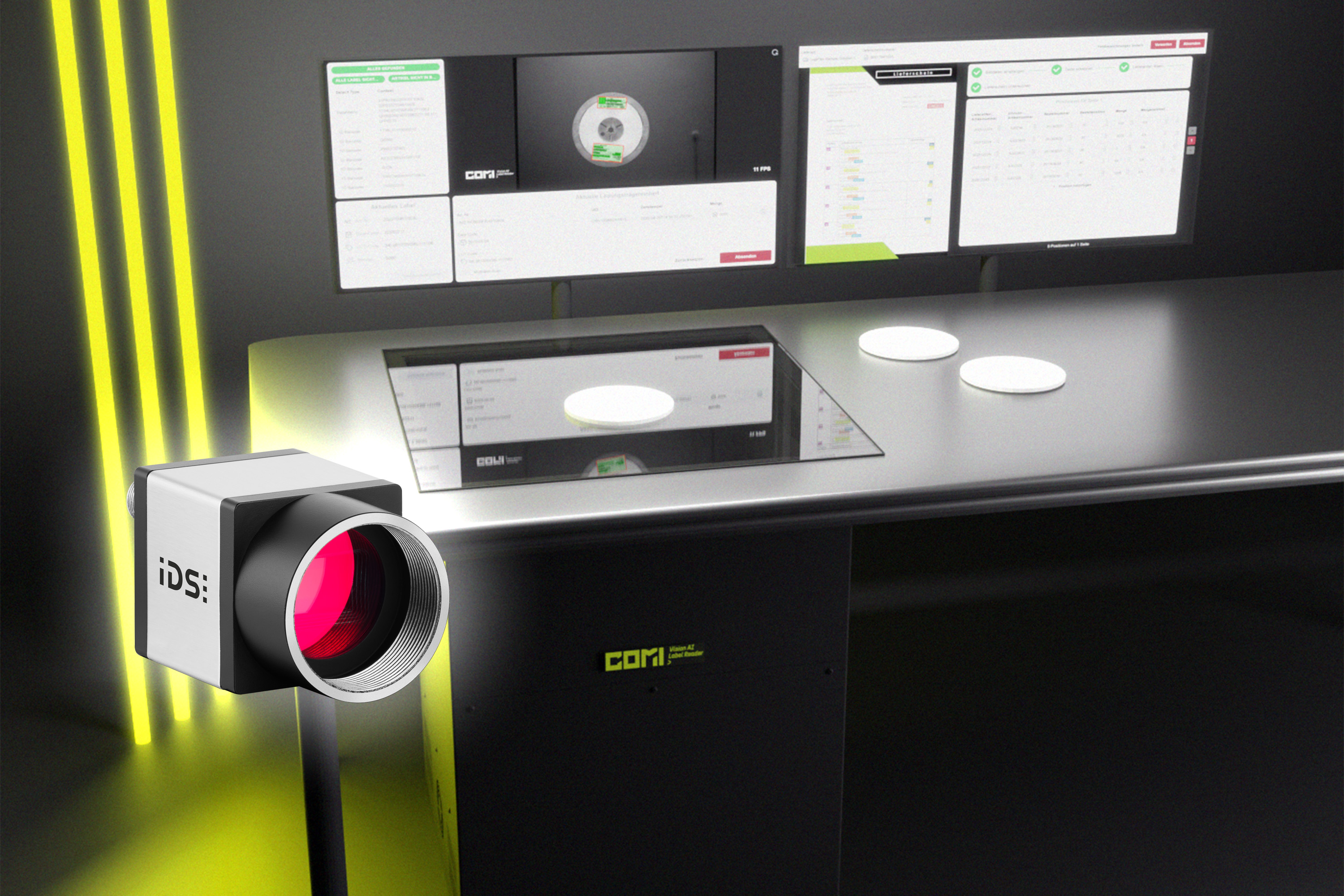
That is why the latest application involving IDS Imaging Development Systems and collective mind GmbH is important. The Vision AI Label Reader from collective mind GmbH, also known as COMI, uses AI-based image processing to automatically capture and interpret label information regardless of layout, language or code type. A uEye CP industrial camera from IDS provides the image data needed for the analysis.
For us, this is a strong example of practical industrial AI. The system is not being presented as an abstract AI concept. It is already being used in a real goods-in environment at Rutronik Elektronische Bauelemente GmbH, a broad-line distributor of electronic components.
Why IDS Vision AI Label Reader matters for manufacturing
IDS Vision AI Label Reader matters because goods-in is often where poor data quality starts.
If label information is captured incorrectly at the beginning of a process, that mistake can travel through the factory, warehouse or ERP system. In sectors such as electronics, medical technology and regulated manufacturing, this can affect traceability, quality documentation and customer confidence.
The Vision AI Label Reader is designed to recognise all labels on an object, read printed text, process 1D and 2D codes and interpret the content using artificial intelligence. According to IDS, handwritten entries can also be processed where required.
The key point is that recognition does not rely on predefined label standards. New layouts, languages and code formats can be handled without retraining. That is important because logistics teams rarely control the exact label design used by every supplier.
For manufacturers, this means AI can support a more flexible goods-in process without requiring every supplier label to follow the same structure.
Camera and AI working together
The camera is central to the system.
COMI uses an IDS uEye CP industrial camera to capture labels and packaging surfaces at high resolution. This image data is then used by the AI system to identify and interpret label content.
Goods-in environments can be difficult for machine vision. Reflective packaging, dry packs, damaged codes and changing lighting conditions can all reduce recognition reliability. IDS says the system addresses this through the combination of high-resolution image capture and a coordinated lighting concept.
The camera used by COMI is equipped with Sony’s IMX183 rolling shutter CMOS sensor from the STARVIS series. The uEye CP camera has a compact magnesium housing measuring 29 × 29 × 29 mm and weighs around 50 g. IDS says the model provides 20.44 megapixel resolution and a frame rate of almost 20 frames per second.
Tobias Husemann, Senior Consultant at COMI, said: “With a resolution of 20.44 megapixels and a frame rate of almost 20 frames per second, the camera provides exactly the level of detail we need to reliably capture even very small label information.”
That level of detail is especially relevant when a label includes small batch codes, supplier markings, compact product IDs or dense 2D codes.
From label reading to structured ERP data
The real value of IDS Vision AI Label Reader is not limited to reading a label.
After image acquisition, the AI analyses the information in several stages. Labels are localised, content is extracted and the system then semantically interprets the data. This allows the system to assign part numbers, batch details and manufacturer information more clearly.
The results can then be transferred directly to connected ERP systems such as SAP or proALPHA, including real-time comparison and validation.
This is where the technology becomes more than a camera application. It becomes part of the data layer of the factory or warehouse.
For companies with complex inventories, this can reduce manual inspection steps, improve data quality and support complete documentation of item movements. IDS says the system can support 100 per cent traceability, which is increasingly important for downstream industries with stricter regulatory requirements.
Efficiency gains in goods receipt
IDS says practical use shows an efficiency gain of around 30 per cent in item capture compared with conventional multi-label readers.
That is a useful figure because it connects AI vision directly to operational performance. In goods-in departments, a 30 per cent improvement in item capture can reduce bottlenecks, free up staff time and improve process reliability.
The system also supports automated plausibility checks. This means label content can be checked earlier in the process, helping teams identify possible errors before they move further into production, stock control or customer delivery workflows.
For manufacturers dealing with high component volumes, that can have a meaningful impact on throughput and traceability.
MTN analysis: why this is a useful industrial AI example
We see IDS Vision AI Label Reader as part of a wider shift in machine vision.
AI inspection and AI recognition systems are now moving beyond final quality control. They are increasingly being applied at the point where production, logistics and data quality meet. Goods-in is a good example because the work is repetitive, data-heavy and error-sensitive.
This also connects with a wider trend we have covered on MachineToolNews.ai: industrial AI becomes most valuable when it is linked to a specific production problem. In this case, the problem is not vague digital transformation. It is the daily challenge of reading inconsistent, multilingual, damaged or reflective labels quickly and accurately.
That makes the application relevant to electronics manufacturing, precision component supply, warehouse automation, medical technology supply chains and any manufacturer where traceability starts at goods receipt.
It also shows why camera hardware still matters in AI systems. The AI model can only interpret what the image acquisition system captures. Resolution, lighting, sensor performance, depth of field and reliable integration all affect the outcome.
From tabletop scanner to automated warehouse system
IDS says the Vision AI Label Reader is expected to move beyond tabletop scanner use and become more fully integrated into automated warehouse and material flow systems.
That direction is important. If goods-in label recognition can be connected to automated handling systems, ERP validation and quality inspection, then AI-based image processing becomes part of a broader automated logistics workflow.
Husemann said future systems will need to cope with changing and unfavourable lighting conditions, reflective surfaces and labels presented at different heights and distances. That points to a more demanding role for industrial camera technology as AI vision moves deeper into automated material flow.
The functional scope of the system is also expected to expand. Alongside item capture, COMI is looking at anomaly and defect detection, including damaged labels, adhesive residues and defective items.
That would turn the system from a label capture tool into a wider quality and inspection platform for goods-in.
Key Takeaways
IDS Vision AI Label Reader uses AI-based image processing to automatically capture and interpret label information in goods-in and logistics.
The system can read printed text, 1D codes, 2D codes and, where required, handwritten entries without relying on fixed label standards.
A uEye CP industrial camera from IDS provides the high-resolution image data needed for AI analysis.
The system is already in use at Rutronik Elektronische Bauelemente GmbH.
IDS says practical use shows an efficiency gain of around 30 per cent in item capture compared with conventional multi-label readers.
FAQ
What is the IDS Vision AI Label Reader?
IDS Vision AI Label Reader refers to an AI-based label recognition application using the Vision AI Label Reader from collective mind GmbH and an IDS uEye CP industrial camera. It automatically captures and interprets label information in goods-in and logistics environments.
What problem does the Vision AI Label Reader solve?
The system helps manufacturers and logistics teams deal with changing label layouts, multilingual markings, damaged barcodes, reflective packaging and high throughput requirements.
Which IDS camera is used in the system?
COMI uses a uEye CP industrial camera from IDS Imaging Development Systems. The model referenced by IDS uses a Sony IMX183 rolling shutter CMOS sensor and provides 20.44 megapixel resolution.
How does the system improve traceability?
The AI extracts and interprets label data such as part numbers, batch information and manufacturer details, then transfers the structured data to ERP systems such as SAP or proALPHA.
How much efficiency improvement does IDS report?
IDS says practical use shows an efficiency gain of around 30 per cent in item capture compared with conventional multi-label readers.
Further Reading on MachineToolNews.ai
IDS Camera Technology Brings AI-Supported Inspection Closer to the Shop Floor
MVTec and ZEISS Team Up to Advance AI Inspection
How Machine Shops Are Using AI to Reduce Scrap Rates
External Sources



One Comment