Siemens has launched a major new release of its Simcenter software portfolio, bringing Siemens and Altair simulation technologies together inside a unified engineering simulation offer.
The release adds expanded AI-driven simulation, GPU acceleration and new multiphysics workflows designed to help engineers explore more design options, reduce reliance on slow simulation cycles and make better decisions earlier in product development.
For manufacturers, this is a significant industrial AI development because simulation is moving closer to the front end of design, validation and production planning. Instead of using simulation only as a late-stage check, Siemens is positioning Simcenter as a platform that can help engineering teams evaluate more possibilities before tooling, machining, forming, casting or assembly decisions are locked in.
The update also marks an important step in Siemens’ integration of Altair technologies following its acquisition of the simulation software specialist. Siemens says this is the first Simcenter release to bring Siemens and Altair technologies together in a unified simulation portfolio.
For readers following AI in machining, Software / CAM / IIoT and the wider rise of industrial AI in factories, the question is simple: can AI-powered simulation help manufacturers test more ideas before anything reaches the shop floor?
AI Moves Deeper Into Engineering Simulation
The most important part of the release is the expansion of Simcenter PhysicsAI, Siemens’ geometric deep learning technology for simulation.
Siemens says PhysicsAI can turn simulation data into predictive models that allow engineers to evaluate more concepts and make faster design decisions. According to Siemens, the technology can help engineers make design decisions up to 1,000 times faster than traditional solver simulations.
That matters because detailed simulation has often been powerful but slow. Engineering teams may know simulation can improve a product, but they do not always have the time to run every scenario, test every variant or analyse every design direction before project deadlines arrive.
By expanding PhysicsAI across the Simcenter portfolio, Siemens is trying to make simulation less of a bottleneck and more of a real-time design tool.
The technology is now being integrated across more Simcenter products, including Simcenter Inspire, where it can support structural simulation, casting, moulding, die stamping and extrusion processes.
That makes this launch highly relevant to metal manufacturers. Casting, forming, extrusion, structural performance and thermal behaviour all sit close to the production challenges faced by machine builders, automotive suppliers, industrial equipment manufacturers and component producers.
Why This Matters For Metal Manufacturers
Metal manufacturers are under constant pressure to produce lighter, stronger, more efficient and more cost-effective components.
That usually requires more design exploration, more simulation, more validation and tighter links between engineering and manufacturing.
The problem is that conventional simulation workflows can limit how many options engineers can realistically test. A team may only have time to validate a few promising designs, rather than explore a much wider design space.
Siemens is trying to change that equation.
The latest Simcenter release is designed to help engineering teams identify promising concepts earlier, reduce time spent on repetitive simulation runs and increase confidence before a design moves toward production.
For manufacturers, that could mean:
Faster design exploration
More design variants before production
Earlier simulation during product development
Reduced physical prototyping
Better decisions before tooling or machining begins
Improved confidence in thermal, structural and fluid behaviour
More connected engineering workflows across teams
This is important because AI in manufacturing is no longer only about robots, cameras or CNC controls. It is also moving into the engineering layer that shapes what gets manufactured in the first place.
That links directly with broader MachineToolNews.ai coverage of industrial AI in CNC machining and the rise of the manufacturing copilot, where AI tools are beginning to support decisions before the first cut is made.
GPU Acceleration Could Push CFD Workflows Forward
The update also expands GPU acceleration across the Simcenter portfolio.
Siemens says multi-GPU support in Simcenter STAR-CCM+ allows engineers to train AI models from computational fluid dynamics simulations significantly faster, with speed improvements of 10 times and beyond.
For engineering teams working on cooling, airflow, fluid systems, electric powertrains or thermal management, this could be an important improvement.
CFD is highly relevant to manufacturing because many products now need to be optimised for performance, energy use, heat transfer and airflow before they are released into production.
Faster CFD-based AI model training could allow companies to explore more design alternatives without waiting for every case to be solved through traditional simulation.
For automotive, aerospace, energy, industrial machinery and electronics manufacturers, this is where simulation becomes a competitive tool. The ability to test more designs faster can affect product performance, bid response, development cost and time-to-market.
PhysicsAI Generate Points To Generative Engineering
Siemens has also introduced Simcenter PhysicsAI Generate, which allows teams to create new design concepts using existing product data, target dimensions and performance requirements.
This is important because it moves AI beyond prediction and into concept generation.
Siemens says PhysicsAI Generate uses a physics-aware generative AI engine to create design concepts in seconds. The strongest implication is that AI could help engineers explore a wider design space before narrowing the options for detailed simulation and production review.
For metal manufacturing, that opens an important question.
Could future AI simulation workflows help engineers generate components that are lighter, stronger, easier to cool, easier to cast, easier to form or easier to machine?
That is where AI-powered simulation starts to overlap with design for manufacturing.
Simulation Is Moving Earlier In The Design Process
Another important part of the release is the integration of Simcenter Simsolid with Siemens Designcenter.
Simcenter Simsolid allows simulation to run directly on geometry without creating a mesh, helping designers assess performance in minutes rather than hours.
This could be highly relevant to manufacturers because simulation often becomes a bottleneck when only specialist analysts can run complex studies. If more engineers can evaluate performance earlier in design, problems may be found before they become expensive manufacturing issues.
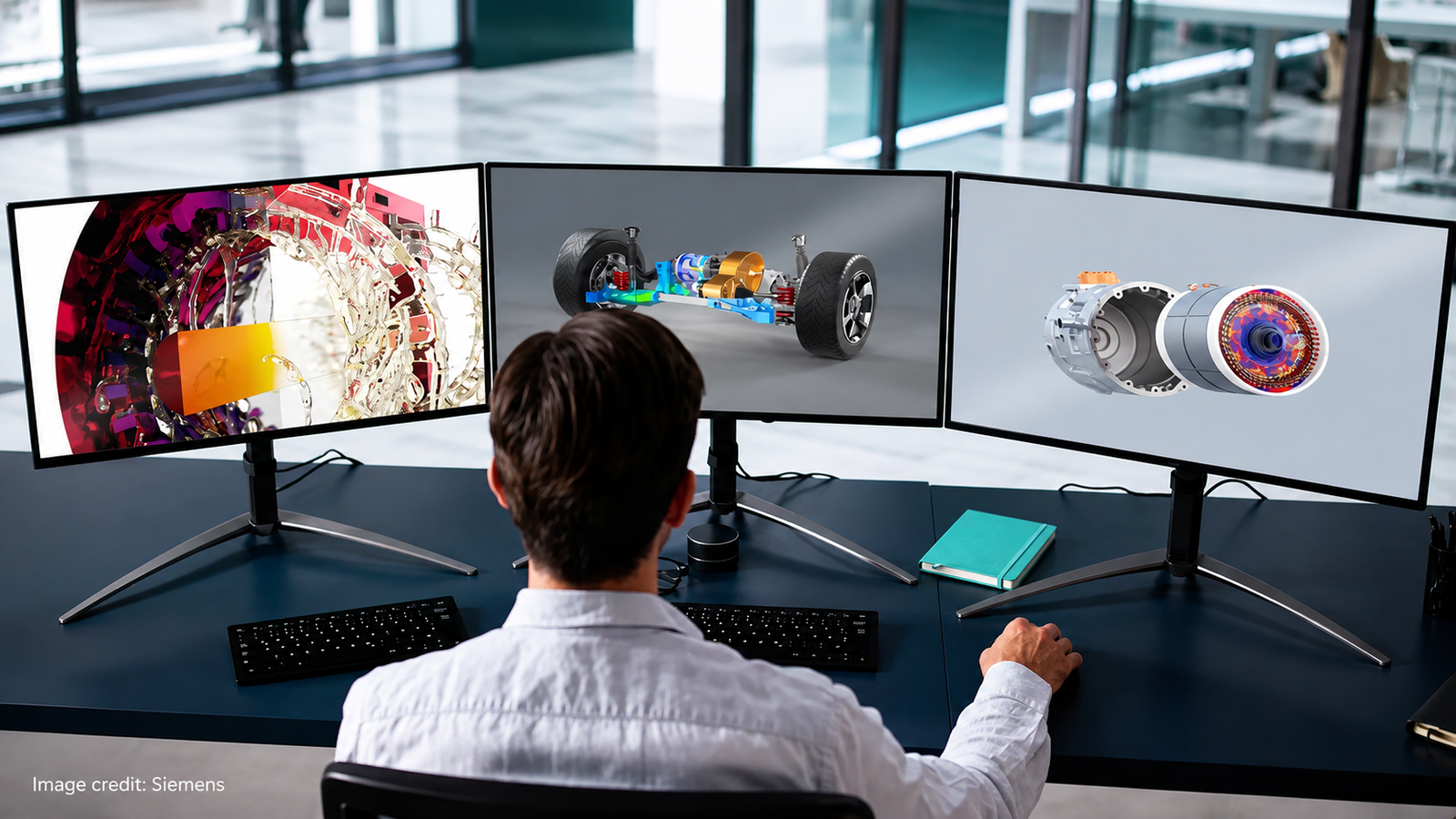
The release also adds stronger multiphysics connections. Siemens says engineers can link electromagnetic, thermal and system simulation workflows more effectively, including exporting reduced motor models from Simcenter Flux into system and 3D simulation tools.
This matters for electric vehicles, motors, drives, batteries, industrial equipment and mechatronic systems, where thermal, mechanical, electromagnetic and system-level performance are closely connected.
Siemens And Altair Become A Bigger AI Simulation Force
The Altair element makes this release more than a normal software update.
Siemens is now beginning to show how Altair technologies will sit inside its wider engineering software strategy. That is important because the industrial simulation market is becoming more competitive as major software companies race to add AI, cloud, automation and generative engineering capabilities.
This strengthens Siemens against other major engineering software suppliers including Dassault Systèmes, Ansys and Hexagon.
It also strengthens the wider Siemens Xcelerator story, because simulation, design, automation, digital twins and production data are becoming more connected.
For manufacturers, the commercial value will depend on how easily these tools can move from advanced CAE teams into everyday engineering workflows.
Large automotive, aerospace and industrial equipment groups may be able to benefit quickly because they already have simulation datasets, specialist teams and established digital engineering processes.
Smaller manufacturers may need more accessible workflows, clearer templates and stronger links into CAD, CAM, PLM and production systems before they can use AI-powered simulation at scale.
MTN Analysis
This is one of the more important AI engineering software announcements of the year because it targets a real manufacturing problem: engineers need to test more design options without slowing product development.
The launch also shows that Siemens is not treating AI as a bolt-on feature. It is being pushed deeper into simulation, design exploration, CFD, multiphysics workflows and concept generation.
For machine builders and metal manufacturers, the key shift is that AI is moving upstream. It is starting to influence the engineering decisions that shape components, machines, production systems and manufacturing performance before work reaches the factory floor.
That is commercially significant.
If AI-powered simulation can help manufacturers evaluate more variants, reduce physical prototypes, improve performance and make better decisions earlier, it could change how products are developed before they are machined, cast, formed, welded or assembled.
The big test will be trust. Manufacturers will need to understand when AI predictions are suitable for early decision-making and when high-fidelity solver validation is still essential.
The most likely route is not AI replacing simulation engineers. It is AI helping them screen more options, identify better directions and reserve detailed simulation for the most important designs.
That is where Siemens’ new Simcenter release becomes interesting for the machine tool and metal manufacturing market.
It is not only about faster simulation. It is about changing the pace of engineering before production begins.
FAQs
What has Siemens launched?
Siemens has launched the latest release of its Simcenter software portfolio, bringing Siemens and Altair simulation technologies together with expanded AI-driven simulation, GPU acceleration and new multiphysics workflows.
Why does this matter to manufacturers?
It matters because AI-powered simulation can help engineering teams test more design options earlier, reduce development risk and make faster decisions before products move into production.
What is Simcenter PhysicsAI?
Simcenter PhysicsAI is Siemens’ geometric deep learning technology for simulation. It uses simulation data to create predictive models that can help engineers evaluate concepts faster than traditional solver-based simulations.
What is Simcenter PhysicsAI Generate?
Simcenter PhysicsAI Generate is a generative engineering tool that can create new design concepts using existing product data, target dimensions and performance requirements.
How does Altair fit into the release?
Siemens says the release is the first to bring Siemens and Altair simulation technologies together in a unified Simcenter portfolio, creating more connected engineering workflows.
How could this help metal manufacturers?
It could support faster design exploration, casting and forming analysis, structural simulation, thermal assessment, CFD workflows and better design-for-manufacturing decisions.
Is this relevant to machine tools?
Yes. While this is engineering simulation software rather than a CNC control, it affects the upstream decisions that shape machine designs, metal components and production-ready products.