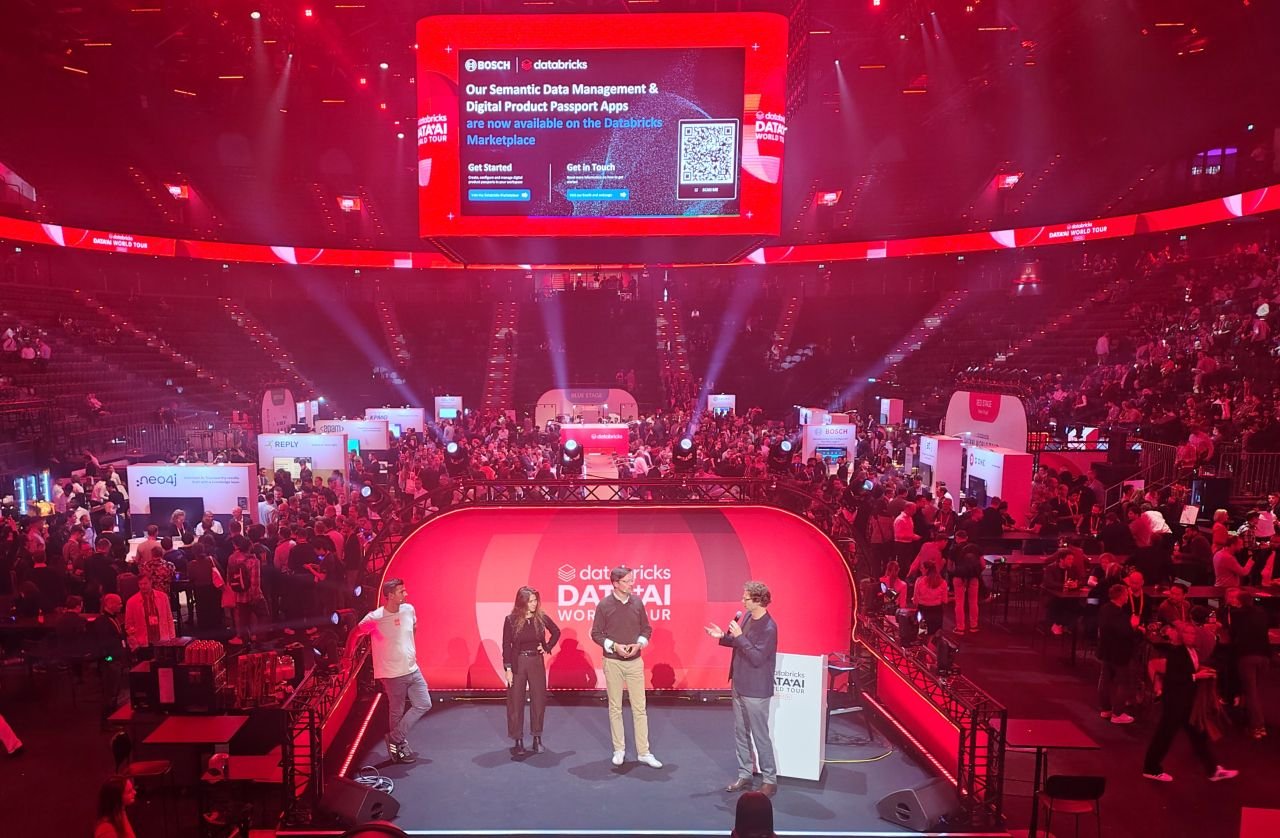
Bosch and Databricks are bringing two manufacturing data applications to Databricks Marketplace, giving manufacturers a new route to prepare product and production information for AI. Announced at the Data + AI World Tour in Munich on 4 November 2026, the Built-On Partnership starts with Semantic Data Management and Digital Product Passport. Both are in private preview, with broader availability planned by the end of 2026.
Image credit: Bosch Connected Industry / LinkedIn.
For engineers evaluating industrial AI, the practical question is whether the same production data can support several applications without being reinterpreted for each project. We see that as the central test of this announcement: can the work invested in defining a component, process or quality record be reused?
What are Bosch and Databricks bringing to manufacturers?
According to Bosch Connected Industry’s announcement, the partnership brings applications from its Manufacturing Co-Intelligence portfolio to the marketplace. Bosch describes a combination of Databricks’ Data + AI Platform, industrial semantics, digital twins and agentic AI.
The initial applications have distinct roles. Semantic Data Management establishes common definitions for industrial information. Digital Product Passport can reuse that information across the product lifecycle. Bosch says the underlying data stays with each company.
Why it matters: what makes factory data usable for AI?
A machine log, an inspection report and an enterprise resource planning record can all refer to the same component while describing it differently. A useful AI application needs to connect those records and interpret their meaning correctly.
Consider a hypothetical machining example. An engineer investigating rejected parts needs the material batch, drawing revision, machining operation and measurement result. If the identifiers do not match, somebody must reconcile them. Adding a conversational interface leaves that engineering task in place.
A semantic model describes the meaning of data and its relationships. The Eclipse Semantic Modeling Framework documentation explains how SAMM represents domain semantics in reusable Aspect Models. Its tools also support model validation and the generation of interfaces such as OpenAPI specifications.
Bosch’s explanation of SAMM places this approach within its digital twin work and the wider Eclipse ecosystem. This gives buyers a concrete technical subject to investigate: how models are defined, maintained and reused across applications.
For readers exploring the wider context, our guide to industrial AI in CNC machining explains the production tasks that can benefit from better operational information.
How does this connect with our earlier Bosch interview?
In our interview with Norbert Jung, CEO of Bosch Connected Industry, he identified semantic data as a foundation for scaling industrial AI. He described the repeated integration work that arises when companies connect information separately for every use case.
Jung also stressed human oversight: engineers validate recommendations and retain responsibility for consequential decisions. That distinction remains useful when assessing Bosch and Databricks. A shared data model supports interpretation, but buyers still need to establish which decisions an application can recommend or execute.
We have heard a related implementation concern from another supplier. In our interview with Fujitsu’s Tim Steward, he highlighted integration with existing production systems, controlled access and traceable decisions as requirements for manufacturing AI.
What should buyers establish before committing?
We would assess Bosch and Databricks against a defined production problem, with the following questions written into the project scope:
- Existing systems: Which ERP, MES, quality and machine-data sources are supported, and which require custom integration?
- Data ownership: Where are records processed, which users can access them, and how are permissions carried into downstream AI applications?
- Model maintenance: Who updates definitions when a drawing, process or supplier changes, and how are those changes checked?
- Total cost: What are the application, platform, integration, training and ongoing support charges?
- Acceptance criteria: Can the team demonstrate reliable answers using its own records and measure the time required to add a second use case?
The announcement does not provide pricing, implementation times, a supported connector list, regional deployment coverage or customer results specific to these two marketplace applications. Those details remain open purchasing questions.
MTN Analysis: measure the second application
We think the most revealing test will come after the first deployment. A project can produce a convincing demonstration while relying on extensive manual preparation. Buyers should record that preparation effort and then measure how much of it carries over into another application.
For example, a manufacturer could first organise component traceability records and then test whether the same definitions support a quality investigation. Useful measures would include engineering hours spent mapping data, missing or ambiguous records, and the time needed to retrieve a complete component history.
These are suggested evaluation measures, not performance results reported by Bosch and Databricks. They give manufacturing teams a way to judge whether reusable data actually lowers their next implementation cost.
For smaller businesses, the decision should also reflect the scale of the problem. We would begin with a bounded workflow, clear ownership and a measurable baseline. A successful trial should demonstrate reliable information, manageable maintenance and a credible route to wider use.
FAQ
What have Bosch and Databricks announced?
A Built-On Partnership bringing Bosch Semantic Data Management and Digital Product Passport applications to Databricks Marketplace.
Can manufacturers buy the applications now?
Bosch describes private-preview access, with broader availability planned by the end of 2026. Public pricing and general access details have not been disclosed in the announcement.
Why does semantic data matter for manufacturing AI?
It defines what industrial records mean and how they relate, helping applications interpret information consistently across different systems.
Does the announcement prove a return on investment?
It provides no measured customer ROI for these marketplace applications. We would evaluate integration effort, information quality and reuse against a manufacturer’s own baseline.
Further Reading
- Our interview with Bosch’s Norbert Jung on agentic AI
- Fujitsu’s Tim Steward on manufacturing AI integration
- Eclipse documentation on semantic modelling
Original reporting/source: linkedin.com