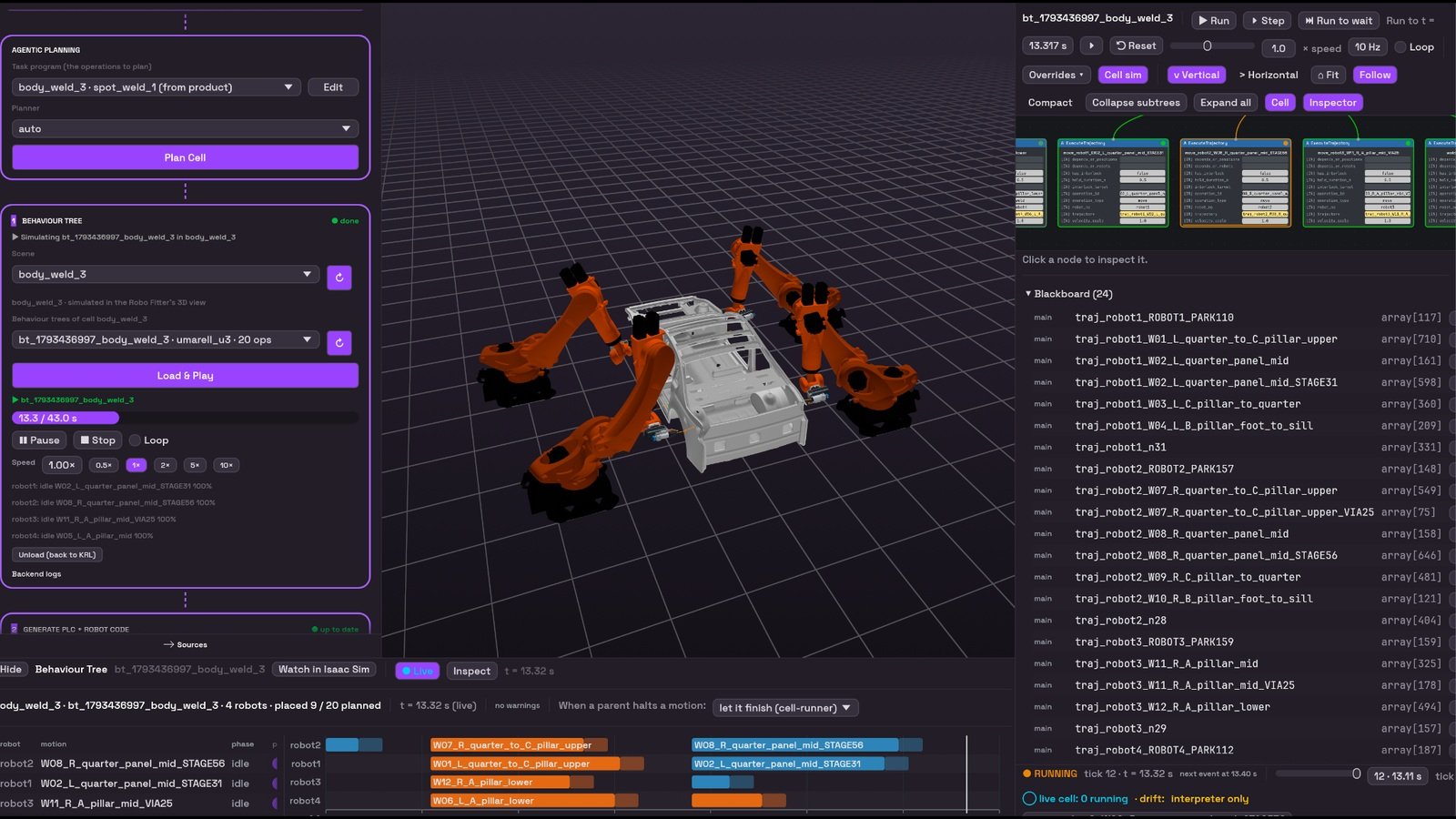
AWS Physical AI Production Designer aims to cut robotic cell programming from weeks to hours by using AI agents to automate production planning, generate robot and PLC code, and validate programs through virtual commissioning. Developed with a global manufacturer, the technology uses AI agents to generate robot and PLC code, test it against virtual controllers and reduce engineering work that can currently take weeks.
Announced on 18 November 2026, Amazon Web Services (AWS) is targeting one of the most time-consuming stages of industrial automation: getting robotic production cells ready for manufacturing.
According to AWS, programming a single robotic cell at the manufacturer involved in developing the solution could take up to eight weeks. Physical AI Production Designer aims to compress much of that work into hours by connecting product engineering data, robot programming, simulation and validation in one workflow.
The potential benefit is particularly significant for automotive manufacturers operating complex production lines with multiple robots, controllers and tooling configurations. However, AWS has not published an independently verified benchmark demonstrating the claimed time reduction across different production environments. AWS for Industries+1
How AWS Physical AI Production Designer Works
Traditional robotic cell development involves several engineering stages, often handled using different software packages.
Engineers import product designs, select robots and tooling, create motion paths, develop PLC logic, test interlocks and commission the equipment. Changes during one stage can require substantial rework elsewhere.
One of the key differences with AWS Physical AI Production Designer is its ability to connect robotic cell planning with code generation and simulation. Instead of treating each engineering stage separately, the solution brings these processes together, allowing engineers to review proposed robot movements and controller logic before physical commissioning.
Physical AI Production Designer connects these activities through a shared engineering environment.
The process begins with product lifecycle management (PLM) data, including component geometry, materials and manufacturing operations. The system combines this information with robot models, fixtures and end-effectors to construct a virtual production cell.
AI agents then help determine which robots should perform individual tasks, how movements should be sequenced and where interlocks are required.
The resulting plans are converted into native robot programs and PLC code rather than requiring engineers to manually translate instructions for each controller.
Importantly, engineers remain responsible for reviewing the proposed cell configuration and approving programs before deployment.
Can AI-Generated Robot Programs Be Tested Before Production?
One of the more important features is the ability to validate generated programs using the robot and PLC manufacturers’ virtual controllers.
Rather than relying entirely on a visual simulation, AWS says the system executes the generated code against virtual control software connected to a physics-based model.
This allows engineers to investigate problems involving robot collisions, motion sequences, controller communication and interlocks before transferring approved programs to physical equipment.
AWS also describes two approaches to robotic control.
The first generates deterministic robot and PLC programs for repeatable production operations. The second uses trained control policies for applications involving frequent product changes or variations in component position.
For adaptive applications, the trained policy operates alongside the production cell, while certified safety functions remain on the safety PLC.
This distinction matters. AI can help generate and optimise robotic movements, but it does not remove the need for safety engineering, commissioning or physical validation.
What Results Has AWS Reported?
AWS has also provided early commercial estimates from its work with the unnamed global manufacturer.
Estimated planning cycle 24 → 15 months
Projected throughput gain 10%+ per robotic cell
The manufacturer estimates that shortening the overall planning cycle from 24 to 15 months could accelerate new production programmes.
AWS also reports a customer projection that improved robot sequencing and interlocks could increase cell throughput by more than 10%, representing approximately €50 million in value per plant.
These are supplier-reported estimates, not independently verified operating results. AWS has not disclosed the calculation behind the financial projection or published measured results from a completed production rollout. AWS for Industries
Can Manufacturers Use Existing Robots and PLCs?
AWS says the solution is designed to work with existing industrial controllers rather than requiring manufacturers to replace their automation equipment.
Its architecture includes IEC 61131-3 PLC programming, vendor-specific robot code, PROFINET communication and OPC UA integration.
The published implementation also references KUKA WorkVisual, CODESYS and NVIDIA Isaac Sim.
However, support for individual robot brands, controller generations and PLM systems needs to be confirmed for each installation. Supporting additional robot programming languages may require adapters and integration work.
The solution is available as AWS solution guidance, with a GitHub repository and a route to discuss pilot projects through AWS. A standard commercial licence price or total deployment cost has not been published.
Why It Matters
For manufacturers investing in robotic automation, programming time is only part of the cost. Engineering changes, repeated simulation work, commissioning delays and dependence on specialist programmers can all affect the economics of a production line.
Physical AI Production Designer addresses these issues by attempting to preserve engineering information throughout the development process.
For automotive manufacturers managing complex production lines, AWS Physical AI Production Designer could reduce repetitive programming work and shorten the time needed to prepare robotic cells for production. The commercial value will depend on how reliably the technology performs with existing robots, controllers and factory systems.
Its ability to bring existing robot programs and production feedback into a virtual environment could also make the approach relevant to established factories, not only new installations.
The strongest potential application is in complex, multi-robot production environments where changes to products, fixtures or operating sequences create repeated programming work.
MTN Analysis
The most interesting aspect of AWS Physical AI Production Designer is not simply that AI can generate robot code.
AWS Physical AI Production Designer represents an attempt to bring AI-assisted engineering into the practical workflow of industrial robotics. The critical question for manufacturers is whether the reported programming time savings can be reproduced across different production environments without increasing commissioning risk or integration costs.
That makes this a more substantial proposition than a standalone programming assistant.
However, manufacturers should distinguish the demonstrated architecture from the commercial projections.
Before investing, we would want to see a completed pilot using existing equipment, measured engineering hours, virtual-to-physical commissioning results, integration costs and evidence of sustained throughput improvements.
The reported potential is significant, but the real test will be whether these benefits can be repeated across different factories, robot brands and production processes.
FAQs
Is AWS Physical AI Production Designer available now?
AWS has published solution guidance and a GitHub repository. Manufacturers interested in implementation are directed to contact their AWS account team. Standard commercial pricing has not been disclosed.
Does the system replace robot programmers?
No. It automates parts of planning, code generation and validation, while engineers retain responsibility for reviewing and approving programs and meeting functional safety requirements.
Can it be used in existing factories?
AWS describes a process for importing existing robot programs, layouts and production data. The feasibility depends on the equipment, available engineering information and controller compatibility.
Has AWS proved that programming can be reduced from weeks to hours?
AWS describes this as an achievable outcome, but has not published an independently verified, multi-site performance study establishing that reduction.
Further Reading
– Yaskawa MOTOMAN NEXT: AI Welding Robot at Toyota GAZOO Racing
How AI-driven robotic welding uses images, sound and process data to assess weld quality and determine whether corrections are required.
– Google DeepMind Gemini Robotics 2.5: AI Robots Tested at Mercedes-Benz
How physical AI is being tested for automotive parts handling and flexible robotic operations.
– Cimatron CAM Agent: Agentic AI for CNC Programming
A related approach to reducing engineering and programming work through AI-assisted manufacturing software.