AI forklift vision is moving from experimental demonstrations into practical factory and warehouse workflows. A case study involving IDS Imaging Development Systems, IT specialist CANCOM and AI developer DENKweit shows how a camera mounted on a forklift can automatically document loading operations. Its AI software filters out more than 99% of captured images before analysing the relevant frames, identifying delivery notes and pallets, and organising records by delivery tour. For manufacturers, the application offers a useful example of how machine vision could reduce paperwork around material movements.
What is the IDS AI forklift vision system?
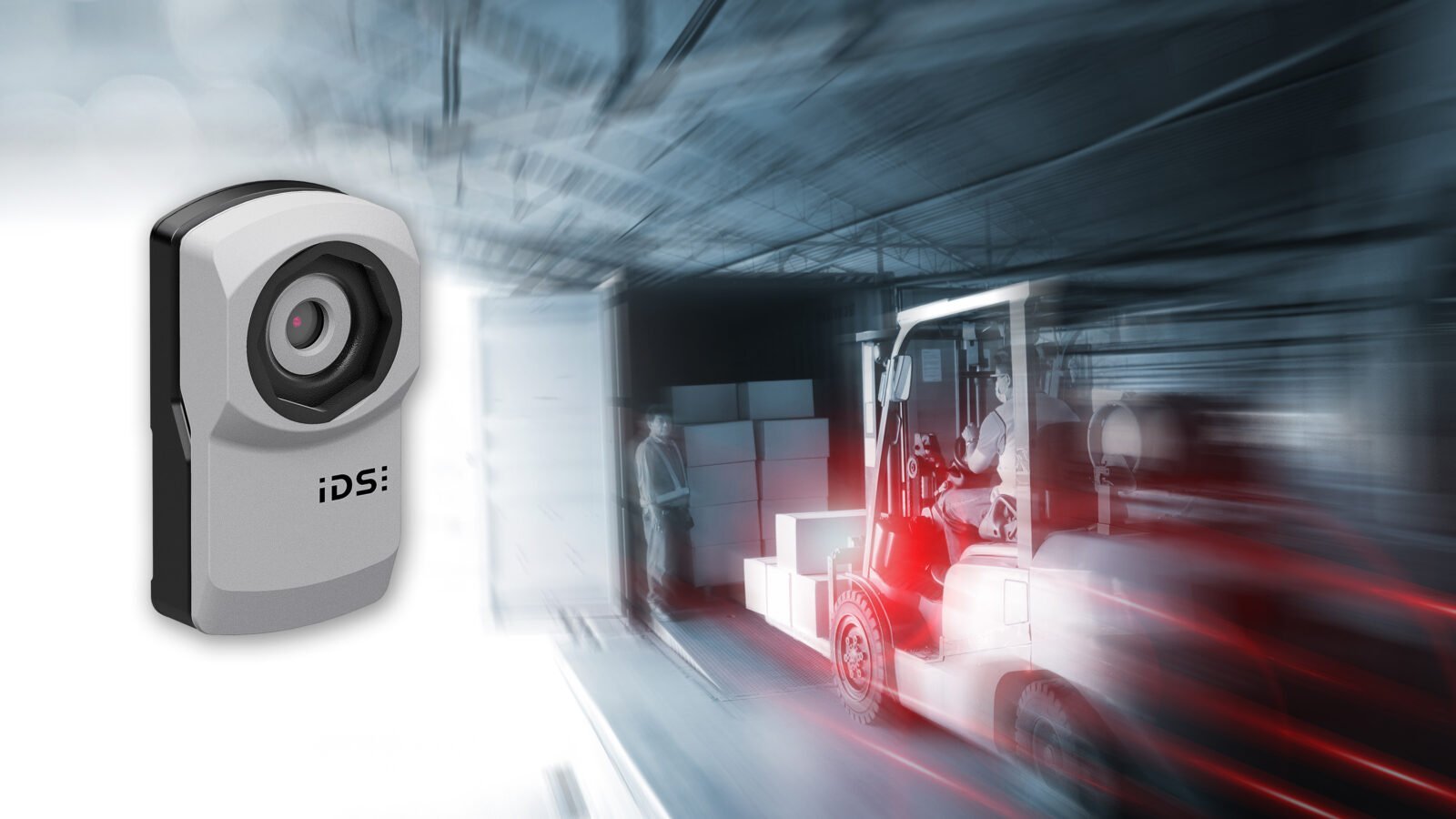
CANCOM developed the loading-documentation application using an IDS uEye XC autofocus industrial camera mounted on the forklift cabin. The camera records the area ahead of the vehicle during normal loading activities. The process can include checking a delivery note, approaching and lifting a pallet, setting it down and documenting the load after the vehicle is parked.
Images travel through a USB Video Class (UVC) connection to the forklift’s Windows IoT terminal, then to a local AI server for analysis. The AI processing comes from DENKweit, using its DENKnet models. This distinction matters: IDS supplies the image-capture hardware, CANCOM integrates the operational solution, and DENKweit provides the image-understanding software.
The aim of AI forklift vision is to collect the evidence needed for traceable loading operations as work happens, reducing the interruptions associated with photographing or recording each step manually.
How does AI forklift vision filter more than 99% of camera images?
The system first uses AI-based image classification to decide which camera frames contain useful information. More than 99% of captured images are filtered out at this first stage, according to the IDS case study. That figure describes the proportion of images excluded from further analysis. It is not a reported accuracy rate, defect-detection rate or guaranteed reduction in operating costs.
DENKweit’s specialised models then analyse the remaining material. Object recognition identifies pallet structures, while optical character recognition (OCR) reads delivery-note information, including the tour number. The software can also identify the number of pallets visible and estimate their dimensions. Relevant images are associated with the tour reference and stored in a structured record.
That creates a more searchable trail of what was loaded and when. For a logistics supervisor, this could help with investigating discrepancies between dispatch paperwork and physical movements. For a manufacturer, it illustrates a broader use for AI vision beyond conventional quality inspection.
Why did CANCOM choose the IDS uEye XC camera?
Loading activities demand a camera that can switch between close-up documents and a wider view of moving goods. The IDS uEye XC in this application uses a 13-megapixel sensor and autofocus. According to CANCOM’s Thomas Fuchs, Team Leader AIoT, the working distance changes from approximately 35 centimetres for a delivery note to around two or three metres when recording pallet movements.
Automatic white balance, colour correction and adjustable brightness, contrast and sharpness help with changing visual conditions. UVC compatibility allows the camera to work without a proprietary driver, simplifying connection to the vehicle terminal and central device management.
Those integration details matter when specifying an AI forklift vision project. A camera must capture usable images in varied warehouse lighting, across different pallet shapes and during normal vehicle movement, before the AI software can produce reliable records.
Where could manufacturers use AI forklift vision?
The reported application concerns forklift loading documentation. We see potential in adjacent workflows where manufacturers already need evidence of material movements, particularly goods-in, dispatch, inter-building transfers and finished-product collection.
For example, sheet-metal processors may need to associate outbound pallets or stillages with orders; machine shops may need better records of incoming stock and completed components; and larger factories may want more consistent documentation at busy loading bays. These are potential applications, not additional deployments confirmed by IDS.
There is also a connection with previous developments in AI-powered visual checks. We have covered how IDS vision AI reads labels during goods-in inspection and how IDS camera technology supports AI inspection closer to the shop floor. The common theme is practical image recognition applied where people otherwise spend time checking and recording information.
What would an AI forklift vision deployment cost, and where is the ROI?
IDS has not published a purchase price, integration budget or measured customer payback period for this application. The case study suggests AI-based methods can shorten development compared with complex rule-based vision systems, but it does not provide a verified site-specific ROI figure.
A manufacturer assessing AI forklift vision should establish a baseline for time spent on manual documentation, missing records, claims investigations and reconciliation between physical loads and paperwork. Pilot measurements should include usable-image rate, recognition performance, integration effort, driver interruptions and the time needed to retrieve evidence.
Costs would depend on the number of vehicles, cameras and vehicle terminals, the AI server infrastructure, software integration, model maintenance and any security or data-retention requirements. DENKweit’s containerised models can run across edge-to-data-centre environments, including Kubernetes deployments with GPU acceleration where appropriate. That flexibility may help multi-site operators, although the right architecture will depend on the application and connectivity.
Why this matters for industrial AI adoption
Many manufacturers first encounter AI cameras in inspection cells. This application points to a second opportunity: using industrial vision to automate the documentation surrounding production and logistics. The value is potentially found in fewer manual steps, better traceability and faster access to supporting evidence.
However, purchasing teams should ask how tour numbers and pallets are validated, what happens when a delivery note is unreadable, how privacy-sensitive footage is managed, and how records connect to existing warehouse management or ERP systems. These operational questions will determine whether a pilot can scale.
MTN Analysis
We think the most interesting feature is the split between straightforward camera hardware and increasingly capable AI software. The IDS camera does not need to perform the full recognition workload itself. CANCOM handles the workflow, while DENKweit’s models decide what deserves analysis and how it should be classified.
Filtering more than 99% of frames before deeper processing is a useful illustration of selective AI inference. It could reduce unnecessary processing, although IDS has not provided comparative compute or energy-consumption figures. For manufacturing buyers, the sensible starting point is a tightly defined documentation task, measured against the current manual process. The same architecture may eventually support a wider range of shop-floor traceability applications.
FAQ: AI forklift vision and loading documentation
Does the IDS camera itself run the artificial intelligence?
No. In the CANCOM application, the IDS uEye XC captures the images. They pass through the vehicle terminal to a local AI server, where DENKweit’s models perform classification, recognition and OCR.
Does filtering 99% of frames mean the system is 99% accurate?
No. It means the first-stage classifier removes over 99% of incoming images from further analysis. The published case study does not supply an end-to-end accuracy or error-rate figure.
Can an AI forklift vision system connect to an ERP or warehouse management system?
Potentially, but buyers should confirm the available interfaces and integration scope with the supplier. The IDS case study describes structured, tour-linked image records, without specifying a particular ERP or warehouse management integration.
Can the system work across several factories or warehouses?
The DENKweit models are containerised and designed to scale from edge infrastructure to data-centre environments. A multi-site rollout would still need validation of networking, data governance, lighting conditions and local operating practices.
Further Reading
- IDS brings AI cameras and edge vision to VISION 2026
- AI inspection and robotic vision: our VISION 2026 preview
- IDS original case study: Every load captured
Source: IDS Imaging Development Systems / CANCOM / DENKweit case study, announced 13 November 2026.