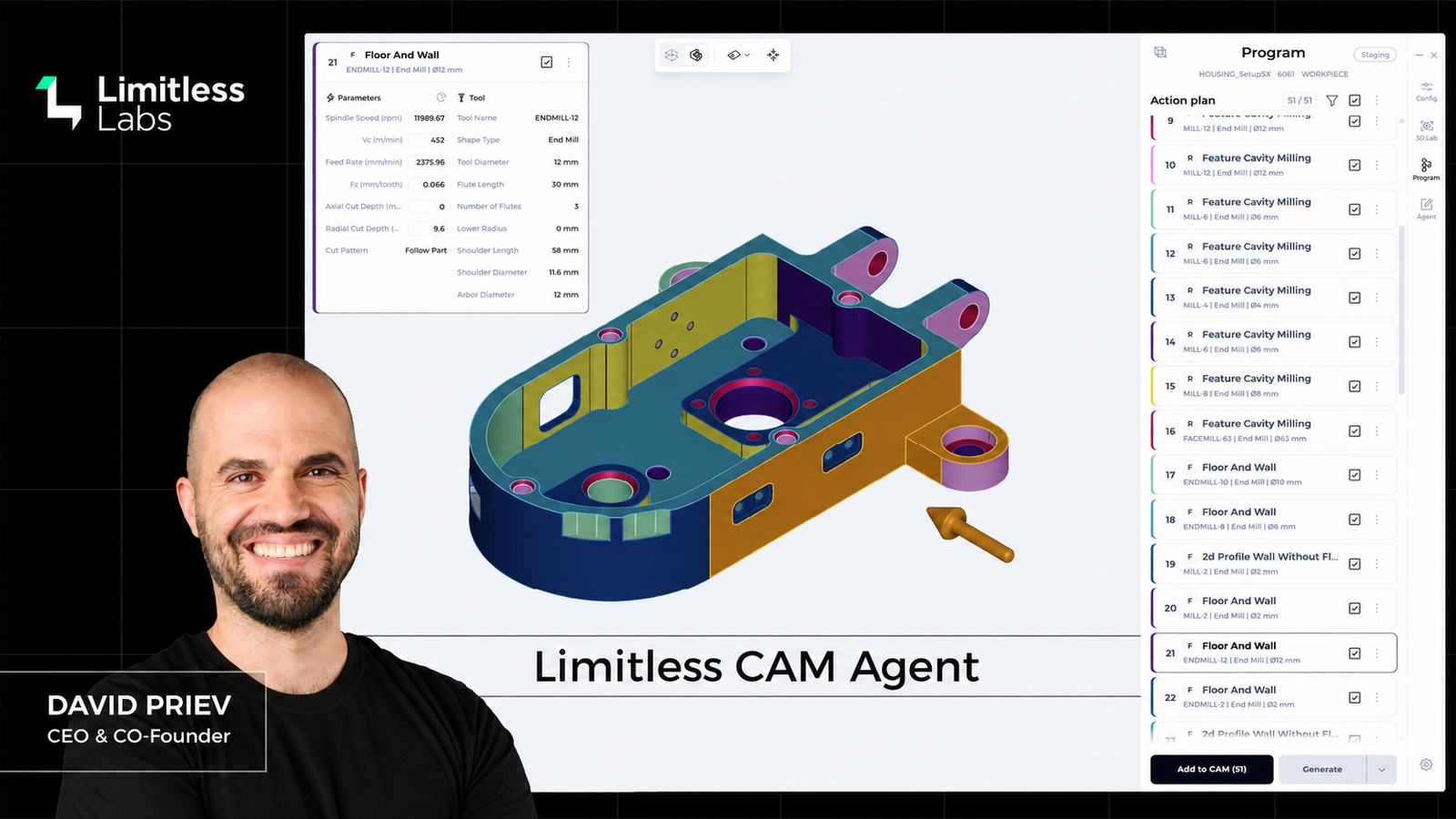
AI is moving rapidly into CNC programming, but Limitless Labs is pushing the technology considerably further than the familiar manufacturing chatbot or software copilot.
The company is building an AI CAM Agent designed to work directly inside the CAD/CAM systems programmers already use, understand the physical realities of machining, learn how an individual machine shop works and generate native CAM operations that remain completely editable by the programmer.
With support for Siemens NX, Mastercam now moving through pilot installations ahead of general availability at IMTS 2026, and PTC Creo on the roadmap, Limitless Labs is aiming directly at one of manufacturing’s biggest bottlenecks: the shortage of experienced CAM programming capacity.
MachineToolNews.ai sat down with David Priev, CEO & Co-Founder of Limitless Labs, to find out how the technology works, why the company has moved into Mastercam, how proprietary manufacturing knowledge is protected and why Priev believes AI will fundamentally change the role of the CNC programmer.
The conversation comes at a pivotal moment for AI in CAM.
MachineToolNews.ai recently reported on the Cimatron CAM Agent, developed with Limitless Labs and set to make its debut at IMTS 2026.
Limitless Labs believes the next step goes much deeper.
At the centre of its approach is what the company calls a Physical AI Foundation Model for precision manufacturing, designed around CAD geometry, machining physics and the operational constraints of real CNC machines rather than relying purely on general-purpose language models.
For machine shops, the proposition is significant: give the AI access to the tools, machines, fixtures, parameters and selected manufacturing knowledge already used by the business, allow it to generate a proposed machining process, then put the experienced programmer in control of reviewing and approving the result.
Here is what David Priev told MachineToolNews.ai.
MTN: Limitless Labs recently expanded to support Mastercam. What drove the decision, and what does it mean for current users?
David Priev: Mastercam is where most North American job shops actually work. We started with Siemens NX because that’s where our first customers were, but if you want to reach the shops making the bulk of precision parts in the US, you have to be inside Mastercam. So that’s what we’re doing.
To be precise about where it stands: it’s running with pilot customers right now, and will be GA at IMTS.
That Mastercam move significantly expands the potential reach of the Limitless technology.
Rather than trying to persuade programmers to move to a new CAM ecosystem, Limitless is taking its AI into the software environments manufacturers have already invested years building their workflows around.
The company will demonstrate its CAM Agent at IMTS 2026, including workflows running alongside both Siemens NX and Mastercam.
MTN: How does the CAM Agent fit into a programmer’s existing CAD/CAM environment without forcing them into a new software suite?
David Priev: The programmer opens CAM the same way they did yesterday. The agent works inside it automatically. There’s no export, no intermediate file format, no “Limitless workflow” to learn.
That matters more than it sounds. A shop’s CAM install isn’t stock software, it’s years of accumulated setup: their post processor, their tool library, their operation templates, their naming conventions. Anything that asks them to leave that behind is asking them to throw away real work.
So we use their fixtures, their tools, their templates. What comes out is native CAM operations.
The programmer can click into any one of them and change it, the same as if a colleague had programmed the part. Mastercam is in pilot on the same principle, and Creo is on the roadmap.
This could be one of the most commercially important aspects of the Limitless approach.
Machine shops do not operate generic versions of CAM software.
Over years of production they accumulate tool libraries, post processors, preferred strategies, operation templates, feeds and speeds and programming conventions that become part of the company’s manufacturing capability.
Limitless is effectively attempting to place an AI programmer on top of that accumulated knowledge rather than asking the manufacturer to start again.
The result is intended to be native CAM operations that can still be opened, inspected, changed and approved by the programmer.
MTN: How does AWS GovCloud ensure sensitive operational data stays protected?
David Priev: We run two deployments, because our customers don’t have one threat model.
ITAR and Aerospace and Defence are deployed in GovCloud, with the access controls and personnel restrictions that the environment requires. Commercial industrial customers run on our standard secured AWS regional cloud.
A shop cutting aerospace hardware under export control and a shop cutting industrial machinery components have genuinely different obligations.
It is important to say, no infrastructure choice makes data “fully protected” on its own. GovCloud is a boundary, and what matters is what you put inside it and who can reach in.
Customer data is isolated per tenant, and part geometry doesn’t move between customers.
For aerospace and defence manufacturers, this is likely to be fundamental to whether AI CAM technology gets through the door at all.
Limitless uses AWS GovCloud for relevant sensitive deployments. The environment is designed by AWS for organisations handling controlled and regulated workloads, including workloads subject to ITAR requirements.
The important point from Limitless is that security does not end with the infrastructure.
How customer information is segregated, who is permitted access and what happens to manufacturing data after it enters the AI system are increasingly becoming part of the buying decision.
MTN: How does the CAM Agent keep proprietary data isolated, unlike public AI models trained on internet data?
David Priev: Two things get mixed together here, and they’re worth separating. One is what a model learned before it ever met you. The other is where your data goes once you start using it. The second one is what actually keeps shop owners up at night.
Your geometry does not train anything shared.
If the agent learns something from your parts, your setups, your feeds and speeds, that stays yours. It doesn’t show up in another shop’s session, and it doesn’t show up in a competitor’s quote.
We put that in writing, because the question we get from every serious customer is the same: if I show you my hardest part, does it help my competitor?
The answer has to be no, and it has to be contractual, not just architectural.
This gets straight to one of the biggest questions surrounding AI adoption in precision manufacturing.
A company’s competitive advantage is often sitting inside its CAM data.
It can be the way an experienced programmer machines a difficult pocket, the cutting parameters that have been refined over hundreds of components, a particular tooling combination, a fixture strategy or the knowledge that one machine behaves differently from another under specific conditions.
That knowledge can be incredibly valuable.
Limitless’ model is designed around retaining that knowledge for the individual manufacturer rather than turning one customer’s machining experience into knowledge available to another.
For companies considering industrial AI, that distinction between using AI and giving away manufacturing IP could become one of the most important procurement questions of the next few years.
MTN: There’s a misconception that automation replaces skilled workers. How is the CAM Agent designed to empower programmers instead?
David Priev: The thing shops are short of was never someone who can drive CAM software. It’s someone with fifteen or twenty years of judgment about how a part is going to behave when the tool touches it.
You can’t hire that, and right now a lot of it is walking out the door into retirement.
So we didn’t build something that replaces judgment. We built something that removes the hours around it.
A programmer spends a large part of the day on setup work they’ve done hundreds of times before. The agent does that pass, and the programmer reviews it, changes what they don’t like, and approves it.
I won’t claim the job stays identical. It shifts from authoring toward reviewing. But the person who decides whether the program is good is still the person who knows.
This may be the most important point in the entire conversation.
The commercial case for AI CAM becomes considerably stronger when the objective is increasing the output of the skilled programmers a manufacturer already has.
Experienced CAM programmers are difficult to recruit, difficult to replace and can carry decades of knowledge about how a company’s machines actually cut parts.
Limitless wants its agent to handle more of the repetitive programming work surrounding those decisions so the programmer can concentrate on the areas where judgement and experience matter most.
What is emerging is a new model for the CAM department.
The programmer becomes less of a person manually constructing every operation and increasingly the expert who reviews, corrects and ultimately approves what the AI has proposed.
MTN: Every shop has unique tooling and parameters. How does the system adapt?
David Priev: By using the shop’s own data instead of handbook numbers.
It reads their actual tool library, so it isn’t proposing an endmill that isn’t in the crib. It reads the machine specifications, the fixture, the stock model condition.
It picks up the feeds and speeds that shop has settled on, which are often nothing like what the catalog says, based on the agent being provided access to selected historical CAM data that the shop wants to preserve as its “know-how”.
That’s most of the reason generic advice fails on a shop floor.
Two shops with the same part and the same machine model will program it differently, and both are right for their situation.
A system that ignores that produces output people spend an hour fixing, which is worse than no output at all.
This is where AI CAM starts to become much more interesting.
A generic system can know how a machining operation should work in theory.
A genuinely useful shop-floor AI needs to understand how your company machines the part.
It needs to know which tools are actually available, which machine will run the job, what fixture is being used, what stock condition it is starting from and which feeds and speeds have already proven themselves in production.
Limitless’ objective is effectively to turn this accumulated shop knowledge into something the AI can apply repeatedly across future parts.
For manufacturers struggling to transfer expertise from senior programmers to less experienced members of the team, that has potentially enormous value.
MTN: What’s the biggest distinction between generic web-based AI tools and a purpose-built solution for high-precision CNC?
David Priev: A chatbot can give you a feed rate. It can’t understand CAD in a native way. Not mentioning the machine, the fixture, the stock, the tool.
Adding to that is the fact that chatbots are not able to analyse the physics at each point of the toolpath.
Those are the two deep technologies we are developing at Limitless Labs, what makes us one of the most advanced applied research groups in the field of physical AI for CNC.
This is the distinction Limitless is putting at the centre of its proposition.
The company isn’t positioning the CAM Agent as ChatGPT attached to a CAM package.
Its technology is being developed around native CAD understanding and the physics of cutting metal.
Limitless describes its platform as the first Agentic Physical AI platform for CAD/CAM in mechanical parts manufacturing, with its Physical AI Foundation Model designed specifically around CNC machining.
That means the AI is being asked to reason about the component, machine, tooling, workholding and cutting process rather than simply retrieve information or respond to a text prompt.
For manufacturers, this is where the gap between general-purpose AI and industrial AI becomes increasingly important.
A useful answer is one thing.
A reliable machining strategy that can be turned into a production-ready CNC program is something else entirely.
MTN: Where do you see the biggest shift in CNC programming over the next few years, and how is Limitless leading it?
David Priev: The role moves from authoring to reviewing.
A programmer today builds operations one at a time. Increasingly they’ll be evaluating a complete proposed process, approving most of it and correcting the parts that reflect something the software couldn’t know.
That’s a better use of an expert.
The second shift is upstream.
Most manufacturing cost gets locked in at the CAD stage, by a designer who has never run the machine that has to make the part. Today that feedback arrives weeks later as a quote nobody likes.
When it arrives while the designer is still working, the fix is cheap.
That’s the direction we’re building. Get the programming right first, then push the intelligence earlier, to where the expensive decisions actually get made.
MTN Analysis: Limitless Is Going After the CNC Programming Bottleneck
There is a bigger story behind the Limitless Labs CAM Agent than saving a programmer a few clicks.
The company is trying to change where the starting point of CNC programming sits.
Today, an experienced programmer typically begins with the component and creates the machining process operation by operation.
The direction outlined by Priev reverses that relationship.
The AI creates the proposed process first.
The programmer starts with something to review.
If Limitless can consistently deliver high-quality proposed processes using the manufacturer’s actual tooling, machines, fixtures, feeds, speeds and historical know-how, the effect on programming capacity could be substantial.
Limitless itself currently reports results across production environments including a 50% reduction in delivery time, a 60% increase in programming capacity and 90% fewer production-stopping errors.
Those are Limitless Labs’ own reported figures, and individual manufacturers will clearly need to validate performance against their own components and workflows. But they illustrate the scale of the productivity problem the company is trying to solve.
The opportunity is particularly significant because CNC programming remains difficult to scale.
Buying another machine does not automatically create another experienced programmer.
Years of machining knowledge cannot be duplicated overnight.
And when a senior programmer leaves, retires or moves to another business, some of the knowledge accumulated over decades can leave with them.
An AI agent capable of learning from approved historical CAM data and repeatedly applying a company’s preferred manufacturing strategies creates a different possibility: manufacturing know-how becomes an asset that can be retained and scaled across the programming team.
That is an extremely powerful proposition.
There is also an important competitive battle developing around the CAM environment itself.
MachineToolNews.ai has already covered Cimatron bringing its CAM Agent to IMTS and the wider wave of industrial AI heading to IMTS 2026.
Limitless Labs sits directly in the middle of that movement.
Its bet is that the winning AI will be the one capable of understanding far more than the CAD model.
It needs to understand the machine shop.
The tools.
The fixture.
The machine.
The material.
The established process.
And ultimately the physics governing what happens when the cutter meets the metal.
If that can be achieved reliably, the CAM programmer’s relationship with software changes dramatically.
The expert remains in control.
But instead of spending hours telling the software how to manufacture a component, increasingly they may be deciding whether the AI already got it right.
See the Limitless Labs CAM Agent at IMTS 2026
IMTS will provide manufacturers with an opportunity to see exactly how far the technology has progressed.
Limitless Labs will demonstrate the CAM Agent on production-representative components at IMTS 2026, September 14-19 at McCormick Place in Chicago.
Visitors can find the company at Booth 237605, North Building, Level 3.
The company says demonstrations will include complete programming output alongside Siemens NX and Mastercam, covering strategy generation, tool selection and cutting conditions calibrated to the material and machine.
David Priev is also scheduled to speak at IMTS in a session titled The First AI Machinist: Automating CNC, CMM, and DFM End-to-End.
For anyone responsible for CNC programming capacity, recruitment, machining productivity or the transfer of manufacturing knowledge, Limitless Labs should be one of the AI companies worth watching closely in Chicago.
MachineToolNews.ai will be at IMTS throughout the week covering the technologies pushing industrial AI further onto the shop floor.
Frequently Asked Questions
Who is David Priev?
David Priev is CEO and Co-Founder of Limitless Labs, an industrial AI company developing an AI CAM Agent and Physical AI technology for precision manufacturing.
What is the Limitless Labs CAM Agent?
The Limitless Labs CAM Agent is an AI system designed to automate parts of CNC programming while operating alongside established CAM environments. It can analyse manufacturing context, propose machining strategies, select tooling and generate native CAM operations for programmer review.
Does the Limitless Labs CAM Agent work with Mastercam?
Limitless Labs says Mastercam support is currently running with pilot customers and is expected to become generally available at IMTS 2026.
Which CAM platforms does Limitless Labs support?
Limitless Labs has developed its technology around Siemens NX and is expanding support into Mastercam. The company also says PTC Creo is on its roadmap.
Does Limitless replace the CNC programmer?
Limitless says the objective is to move more repetitive programming work to the AI while keeping the experienced programmer in control. David Priev expects the role to progressively shift from manually authoring operations towards reviewing, adjusting and approving AI-proposed processes.
Can the CAM Agent use a machine shop’s own tooling?
Yes. Limitless says its system can work with a manufacturer’s actual tool library, machine specifications, fixtures, stock conditions, preferred feeds and speeds and selected historical CAM information.
Does Limitless Labs use customer machining data to train systems for other customers?
Limitless Labs says customer geometry does not train a shared system and that knowledge learned from a customer’s parts, setups, feeds and speeds remains isolated to that customer.
What is Physical AI for CNC machining?
Physical AI in the Limitless Labs context refers to AI developed to understand CAD geometry and the physical processes involved in CNC machining, rather than relying solely on language-based information.
Where is Limitless Labs exhibiting at IMTS 2026?
Limitless Labs will be at Booth 237605 in the North Building, Level 3 at McCormick Place in Chicago from September 14-19, 2026. Book a meeting with Limitless Labs at IMTS 2026.
Further Reading
MachineToolNews.ai recently examined another major application of the Limitless technology in Cimatron CAM Agent Brings Agentic AI Into CNC Programming Ahead of IMTS 2026.
For the bigger picture in Chicago, read IMTS 2026 Industrial AI Takes Centre Stage to see how AI is moving across CAM, CNC machining, robotics, inspection and production software.