Google DeepMind’s Gemini Robotics 2.5 has been tested with Apptronik Apollo 2 humanoid robots in Mercedes-Benz automotive production, achieving a supplier-reported 96% success rate in parts kitting. The trial demonstrates how AI-driven robots could handle component picking and sequencing, but questions remain about production reliability, cycle times and commercial deployment.
Google DeepMind is taking its robotics AI technology into real manufacturing environments.
Announced on 10 November 2026, Gemini Robotics 2.5 is a vision-language-action model designed to help robots interpret visual information, understand instructions and perform physical tasks.
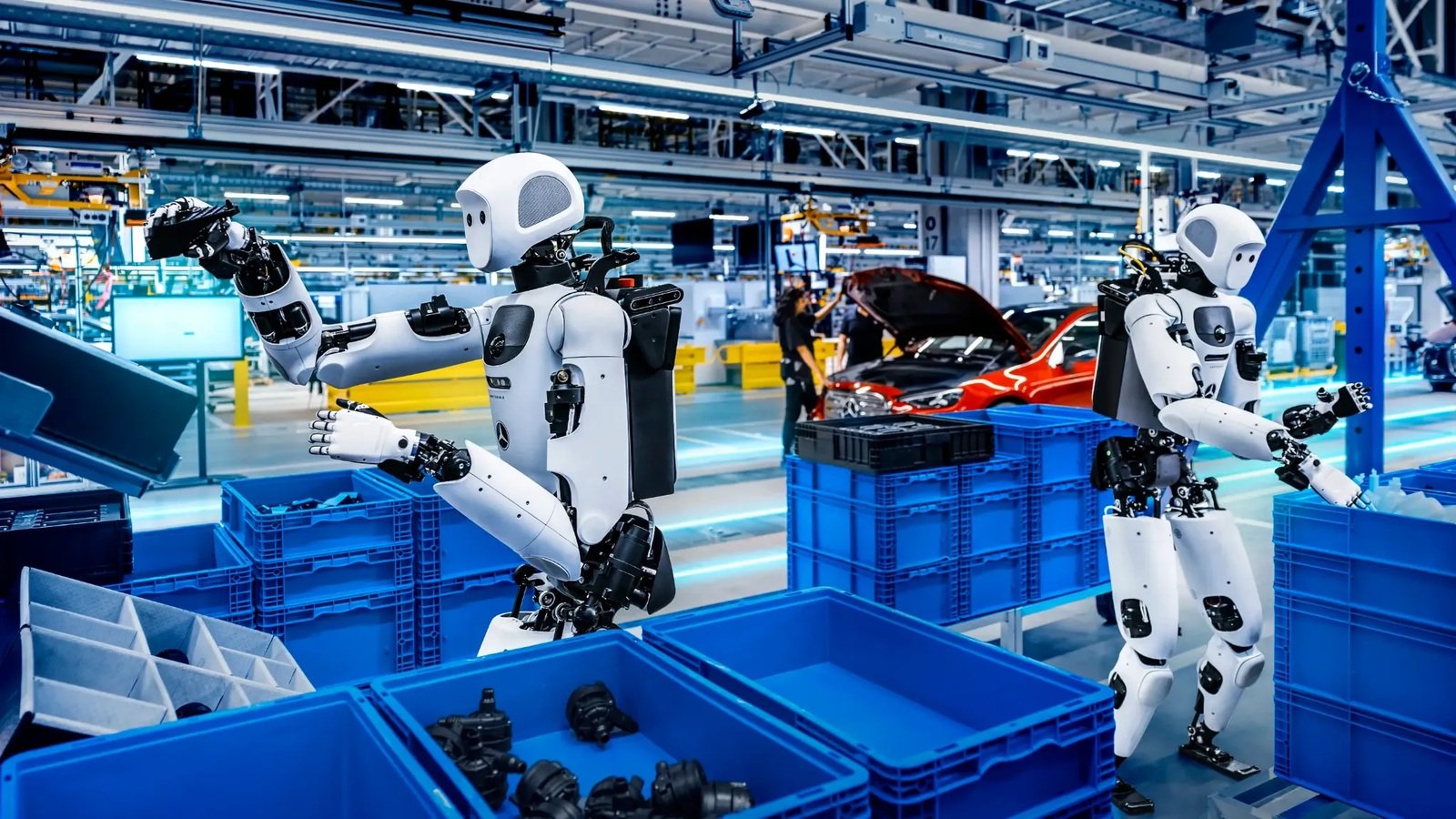
Working with Apptronik and Mercedes-Benz, Google DeepMind tested the technology in automotive manufacturing environments in Germany and Hungary.
The application focused on automotive kitting, where robots pick individual components from supply bins and arrange them in the correct sequence for vehicle assembly.
According to Google DeepMind, the Apollo 2 humanoid robots achieved a 96% success rate during the proof of concept.
The result suggests progress towards more flexible industrial automation. However, the company has not publicly provided enough operational data to establish whether the system can maintain that performance across full production shifts.
How Gemini Robotics 2.5 Handles Automotive Kitting
Automotive kitting is a demanding application for robotic automation because components must be identified, picked and arranged correctly before reaching the assembly line.
Traditional industrial robots can perform these tasks effectively when components and workflows are sufficiently predictable. Greater variation in part positions, presentation and production requirements can increase the engineering effort needed to maintain reliable operation.
In the Mercedes-Benz trial, Apptronik’s Apollo 2 humanoid robots picked metal automotive brackets from supply bins and placed them into sequencing containers.
The system combined two Google DeepMind models.
Gemini Robotics ER provides embodied reasoning capabilities, allowing the system to interpret the task and understand the workflow.
Gemini Robotics 2.5 translates visual information and instructions into physical robot actions, controlling the movements needed to manipulate components.
Google DeepMind says the system can adapt to changes in the task rather than relying entirely on predetermined movement sequences.
For manufacturers, this could eventually reduce the amount of application-specific programming required for certain handling operations.
However, the company has not disclosed the full range of component variations successfully handled during the Mercedes-Benz trial.
What Does the 96% Success Rate Mean for Manufacturers?
The reported 96% success rate is the most commercially interesting figure from the demonstration.
It suggests that the technology can perform a substantial proportion of the assigned tasks successfully in a real manufacturing environment.
However, the result requires careful interpretation.
Google DeepMind has not publicly provided a complete breakdown of the testing methodology, including the total number of attempts, duration of operation or frequency of human intervention.
It is also important to distinguish between successful individual picking operations and the successful completion of entire kits.
For a manufacturer evaluating this technology, several performance indicators would be essential:
- Completed kits per hour and average cycle time.
- Successful picks across different component types.
- Frequency of operator intervention and recovery time.
- Reliability during continuous production shifts.
- Performance when parts are misplaced or supply conditions change.
These figures would allow buyers to compare the system with established robotic bin-picking solutions and manual kitting operations.
Until they are available, the 96% result should be considered a supplier-reported proof-of-concept outcome rather than an independently verified industrial performance benchmark.
Can Gemini Robotics 2.5 Work Across Different Robot Platforms?
One of the potentially significant developments is the model’s ability to operate across different robotic configurations.
Google DeepMind says Gemini Robotics 2.5 has been evaluated on more than 200 tasks involving physical manipulation and interaction with objects.
The company has also demonstrated the model using different robot platforms, including Apptronik Apollo 2 and Franka Duo.
This matters because industrial automation typically requires considerable engineering work when transferring applications between different robots, end effectors and operating environments.
A model capable of transferring learned behaviours between platforms could potentially reduce some of that development effort.
However, cross-platform AI compatibility does not mean that a robot can be installed in a new factory application without additional engineering.
Manufacturers would still need to consider robot controller integration, end-effector selection, safety systems, application-specific training and the physical requirements of the production cell.
The extent to which Gemini Robotics 2.5 reduces those integration costs has not yet been independently established.
How Does Gemini Robotics 2.5 Address Industrial Safety?
Google DeepMind has also highlighted safety-related improvements in the new model.
According to the company’s internal evaluations, Gemini Robotics 2.5 demonstrated improved performance when operating around obstacles and people.
The model is designed to use reasoning during task execution, allowing robots to respond to changing conditions in their environment.
This is particularly relevant to humanoid robots, which are being developed for applications where they may operate in manufacturing environments originally designed around human workers.
However, AI-based obstacle avoidance is not equivalent to a certified industrial safety system.
Any deployment involving humanoid robots and production personnel would still require an appropriate risk assessment, safeguarding measures and validation of the complete robotic installation.
Manufacturers should establish which safety functions are independently monitored and how the robot responds to unexpected failures, lost perception or interrupted communication.
Is Gemini Robotics 2.5 Commercially Available?
Google DeepMind says Gemini Robotics 2.5 is being rolled out to robotics partners.
However, general commercial availability, licensing costs and standard deployment packages have not been publicly confirmed.
The Mercedes-Benz demonstration also does not establish a timetable for widespread production deployment.
For manufacturers interested in the technology, the immediate route would be to investigate availability through Google DeepMind’s robotics partners.
Before investing, buyers should establish the hardware and software requirements, supported robot platforms, integration responsibilities and available technical support.
The absence of publicly disclosed cycle-time and operating-cost data also means that a reliable return-on-investment calculation cannot currently be made from the Mercedes-Benz trial.
Why It Matters
The significance of Gemini Robotics 2.5 lies in its potential to make industrial robots more adaptable.
Many manufacturing operations involve repetitive handling tasks that are difficult to automate economically because components, positions or workflows change frequently.
Conventional industrial robots remain highly effective for repeatable, high-volume applications. However, the programming and integration effort associated with changing tasks can affect the business case for automation.
Vision-language-action models offer a different approach by combining perception, reasoning and physical movement.
For automotive manufacturers, potential applications include parts kitting, material handling and other tasks requiring flexible manipulation.
The Mercedes-Benz trial provides evidence that this approach is being tested in industrial environments.
Whether it can deliver sufficient reliability, throughput and cost efficiency for wider adoption remains an open question.
MTN Analysis
The most important development is not simply that a humanoid robot can pick automotive components.
It is that Google DeepMind and Apptronik are testing a general-purpose robotics model in an automotive manufacturing environment, where the requirements are very different from a controlled laboratory demonstration.
We see automotive kitting as a particularly relevant application because it combines repetitive handling with variation in component presentation and production requirements.
If the system can adapt to these changes without extensive reprogramming, it could address tasks that have traditionally been difficult to automate economically.
However, the reported 96% success rate is only part of the picture.
A manufacturer considering this technology would need to understand what happens during the remaining unsuccessful operations, how quickly the system recovers and whether human assistance is required.
Cycle time is equally important. A flexible robot that completes tasks reliably but significantly more slowly than existing automation may struggle to justify its cost.
There is also the question of whether a humanoid robot is the most appropriate solution. For many kitting operations, conventional robotic arms equipped with advanced vision and gripping systems may offer a simpler and more economical alternative.
The longer-term opportunity for Gemini Robotics 2.5 will depend on demonstrating advantages that extend beyond the ability to perform individual tasks.
For now, the Mercedes-Benz project represents an important industrial proof of concept, but not yet independently demonstrated evidence of a commercially competitive production solution.
FAQ
What is Google Gemini Robotics 2.5?
Gemini Robotics 2.5 is a vision-language-action AI model developed by Google DeepMind. It enables robots to interpret visual information, understand instructions and perform physical tasks.
Which humanoid robots were used in the Mercedes-Benz trial?
Apptronik’s Apollo 2 humanoid robots were used to pick automotive brackets from supply bins and arrange them into sequencing containers.
Did Gemini Robotics 2.5 achieve 96% accuracy?
Google DeepMind reports a 96% success rate during the Mercedes-Benz proof of concept. The result has not been independently verified, and the full testing methodology has not been publicly disclosed.
Can Gemini Robotics 2.5 be used with industrial robots?
Google DeepMind has demonstrated the model across different robotic configurations. However, compatibility with specific industrial robots, controllers and manufacturing systems must be confirmed for each application.
Is Gemini Robotics 2.5 available for manufacturers to purchase?
The technology is being rolled out to robotics partners. General commercial availability, pricing and licensing arrangements have not been publicly confirmed.
Could humanoid robots replace conventional industrial robots?
Humanoid robots could become useful for certain flexible handling tasks, but conventional industrial robots remain well established for high-speed, repeatable manufacturing operations. The appropriate choice depends on the application, performance requirements and total cost of ownership.
Further Reading
For more information about the technology and the Mercedes-Benz demonstration, read the official Google DeepMind Gemini Robotics 2.5 announcement.
For another example of physical AI being applied to manufacturing, read our coverage of Yaskawa MOTOMAN NEXT AI Welding Robot Inspects and Corrects Its Own Welds at Toyota GR.